

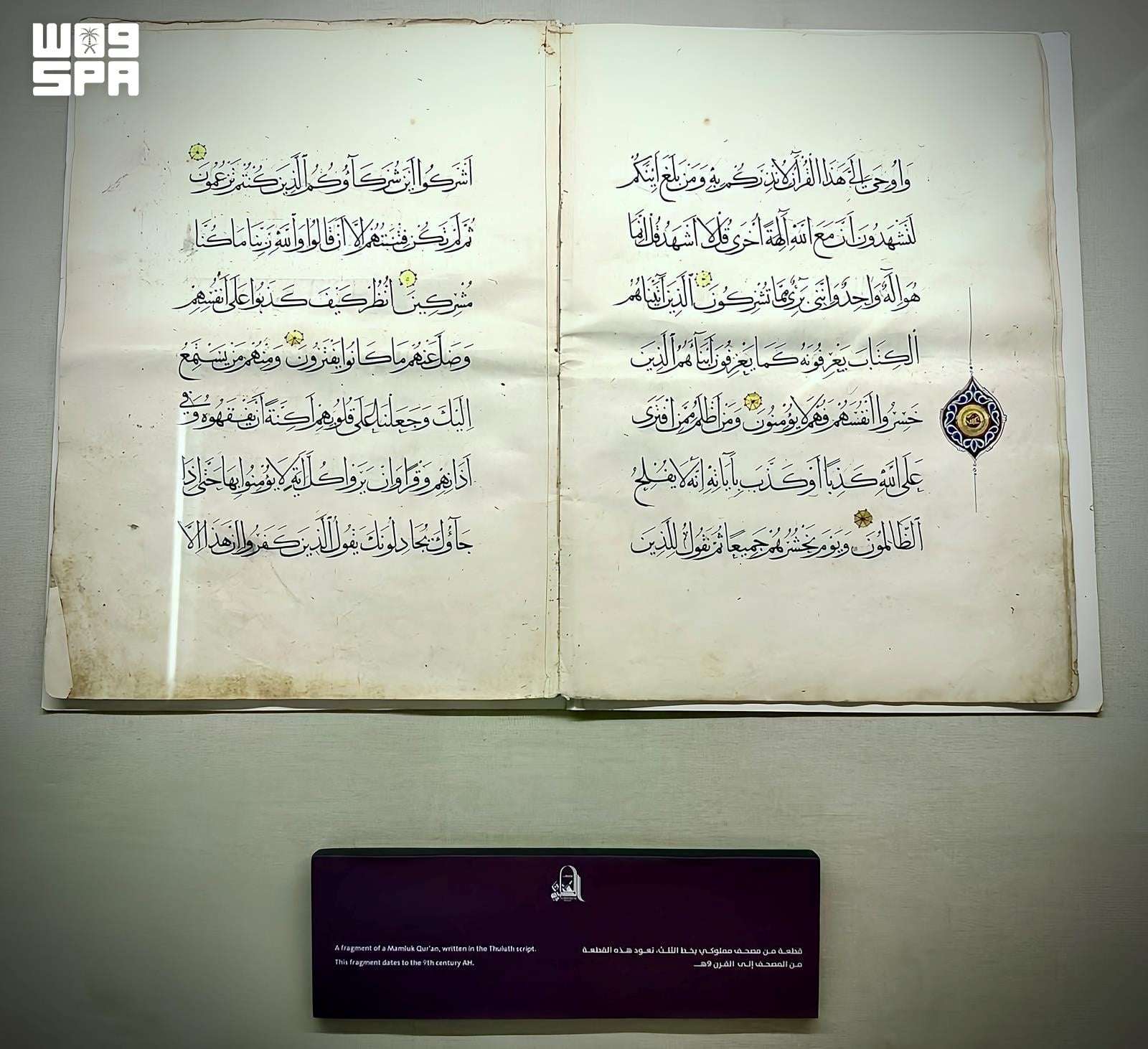
Rare 9th-century AH Qur’an manuscript in Thuluth script on display at Makkah museum
The Qur’an Museum in Makkah’s Hira Cultural District is exhibiting a rare 9th-century AH manuscript in Thuluth script, highlighting the art of Arabic calligraphy.
Key Takeaways
AIThe Qur’an Museum in the Hira Cultural District of Makkah is showcasing a rare Qur’anic manuscript dating back to the ninth century AH, written in Thuluth script—one of the most prominent Arabic calligraphic styles, renowned for its harmonious visual compositions and artistic flexibility.
This exhibit offers visitors a chance to explore the history of Qur’anic transcription and highlights the meticulous care given to calligraphy, ornamentation, and craftsmanship in Qur’anic manuscripts throughout Islamic history, reflecting their religious, artistic, and historical significance.
The significance of Thuluth script in Islamic art
Thuluth script is considered one of the most important Arabic calligraphic styles in Islamic art, known for its balance between elongated letters, graceful curves, and diverse forms. Its ability to create compositions that combine clarity and aesthetic beauty has made it a mainstay in Islamic artwork, architecture, and religious panels.
Characterized by long letters, elegant curves, and carefully planned overlaps, Thuluth script requires a high level of skill to achieve proportional harmony and letter coordination. This has earned it a special status among calligraphers and made it a model for the expressive and functional potential of Arabic calligraphy.
The importance of the manuscript’s display
The Qur’an Museum explained that displaying this piece is part of its efforts to raise awareness of Qur’anic heritage and shed light on the history of the Holy Qur’an, its transcription, and the associated arts of calligraphy, ornamentation, and manuscript production.
The presence of Qur’anic manuscripts written in authentic Arabic scripts underscores the importance of preserving Islamic written heritage, serving as an artistic and cultural record that documents the evolution of Arabic calligraphy and the skills of calligraphers who meticulously transmitted texts across generations.
The Qur’an Museum is one of Makkah’s leading cultural landmarks, offering visitors insights into the history and sciences of the Holy Qur’an in a cultural setting linked to the historic Cave of Hira and its significance in the Prophet’s biography.
The museum also emphasized the importance of specialized museums in safeguarding historical artifacts, making them accessible to the public, and serving as knowledge gateways that reveal the beauty and development of Islamic arts, while highlighting the central place of the Holy Qur’an in Islamic civilization and the rich artistic traditions associated with its transcription.