

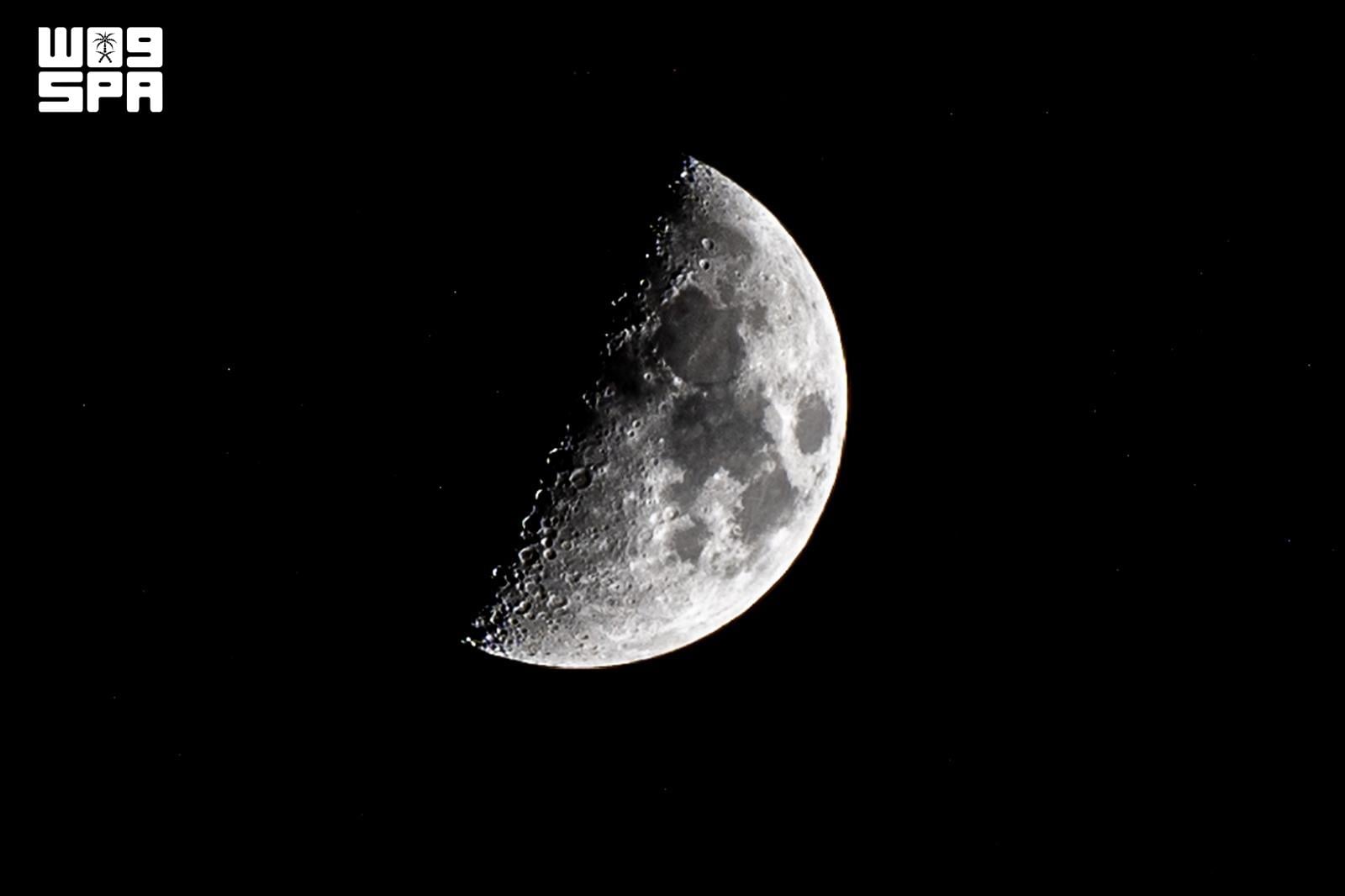
First quarter moon of Jumada Al-Awwal visible over Northern Borders
The moon reached its first quarter phase over Saudi Arabia’s Northern Borders at 7:13 p.m., offering a striking view for astronomy enthusiasts.
Key Takeaways
AIThe skies over Saudi Arabia’s Northern Borders region witnessed the moon of Jumada Al-Awwal 1448 AH reaching its first quarter phase this evening, with half of its disk illuminated by sunlight. This astronomical event offers an opportunity for photography and astronomy enthusiasts to observe the moon’s surface and terrain in detail.
Adnan Khalifa, a member of the Astronomy and Space Club, stated that the moon reached the first quarter at 7:13 p.m. local time. He explained that this phase occurs when the moon has completed about a quarter of its orbit around Earth since the new moon, forming an almost right angle with the sun as seen from Earth. As a result, half of the moon’s disk facing Earth is lit, while the other half remains in darkness.
Best times for observing lunar terrain
Khalifa noted that the first quarter is one of the best times to observe the moon’s surface features using binoculars or telescopes. He explained that sunlight striking the areas near the boundary between the illuminated and dark portions of the moon at an oblique angle highlights craters, highlands, and mountain ranges due to the sharp contrast between light and shadow.
Viewing times and the coming days
He added that during this phase, the moon appears high in the sky after sunset and remains visible during the early hours of the night, setting around midnight. The illuminated portion of the moon’s disk will gradually increase in the coming days, reaching the full moon phase.
Khalifa said that following the lunar phases is an opportunity to enhance astronomical awareness in the community, encouraging enthusiasts and interested individuals to engage in skywatching and astrophotography, and to learn about celestial phenomena related to the moon’s orbit around Earth.