

Smart guidance system launched to enhance religious Q&A at Two Holy Mosques
A new AI-powered system to improve religious guidance and answers for visitors to the Grand Mosque and Prophet’s Mosque was launched in Makkah.
Key Takeaways
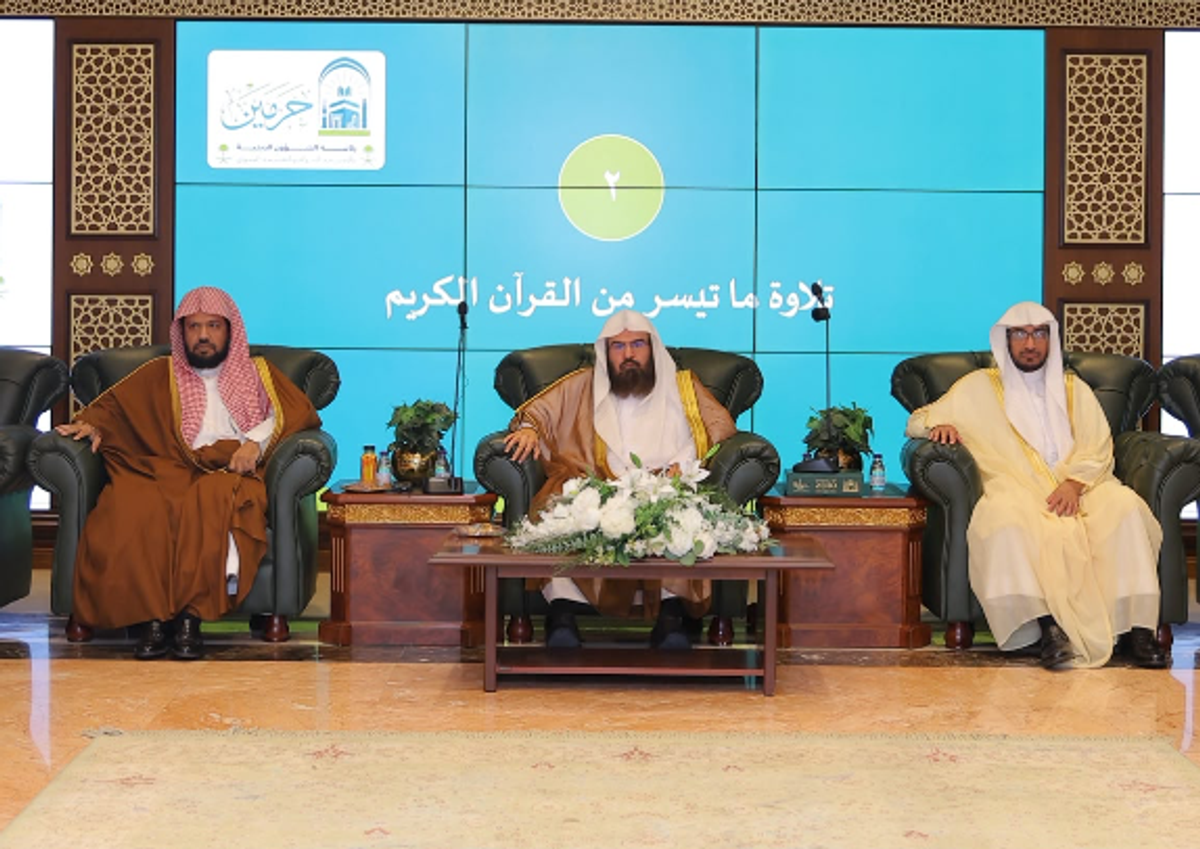
AIThe President of Religious Affairs at the Grand Mosque and the Prophet’s Mosque, Sheikh Dr. Abdulrahman bin Abdulaziz Al-Sudais, launched a project to enhance the service of answering visitors’ religious questions through the new “Smart Guidance and Shariah Answering System.” The initiative aims to harness artificial intelligence technologies to advance religious services for visitors to the Two Holy Mosques.
The launch was attended by the Assistant President for Religious Affairs at the Prophet’s Mosque, Sheikh Dr. Ahmed bin Ali Al-Hudhaifi, the mosque’s imams Sheikh Dr. Abdullah bin Abdulrahman Al-Buaijan and Sheikh Saleh bin Awad Al-Maghamsi, as well as several senior officials from the Religious Affairs Presidency.
The project utilizes artificial intelligence to provide guidance and religious answers through a smart assistant that receives users’ questions and responds to frequently asked and approved queries based on trusted sources. It also offers support tools for religious specialists, such as summarizing questions and providing access to relevant references.
Sheikh Dr. Al-Sudais emphasized the importance of leveraging modern technologies and AI to develop religious services, enabling visitors to the Two Holy Mosques to access approved religious answers around the clock and in multiple languages. This, he said, will help reduce waiting times, ensure consistency in answers, and allow the use of service data to identify visitors’ needs and peak periods.
The system is built on scholarly oversight and human supervision. Automated answers are limited to approved topics and frequently asked questions, while complex or interpretive issues are referred to religious specialists. The system ensures knowledge sources are documented, performance is continuously reviewed, privacy is protected, and users are informed when an answer is automated, with the option to consult a specialist.
Project components include a text-based assistant, a voice assistant currently under technical evaluation, support tools for specialists, a governed religious knowledge base, and a center to monitor performance and service quality. The project will be implemented in phases, including design, pilot testing, and full launch, in line with standards for religious, linguistic, security, and operational quality.
The initiative reflects the leadership’s ongoing commitment to the Two Holy Mosques and their visitors, and aligns with Saudi Arabia’s drive to adopt advanced technologies and build an integrated digital system in support of Vision 2030 goals.