

UK skills minister praises Saudi model for education quality and data use
Baroness Jacqui Smith commends Saudi Education and Training Evaluation Commission for its advanced data-driven approach and continuous improvement.
Key Takeaways
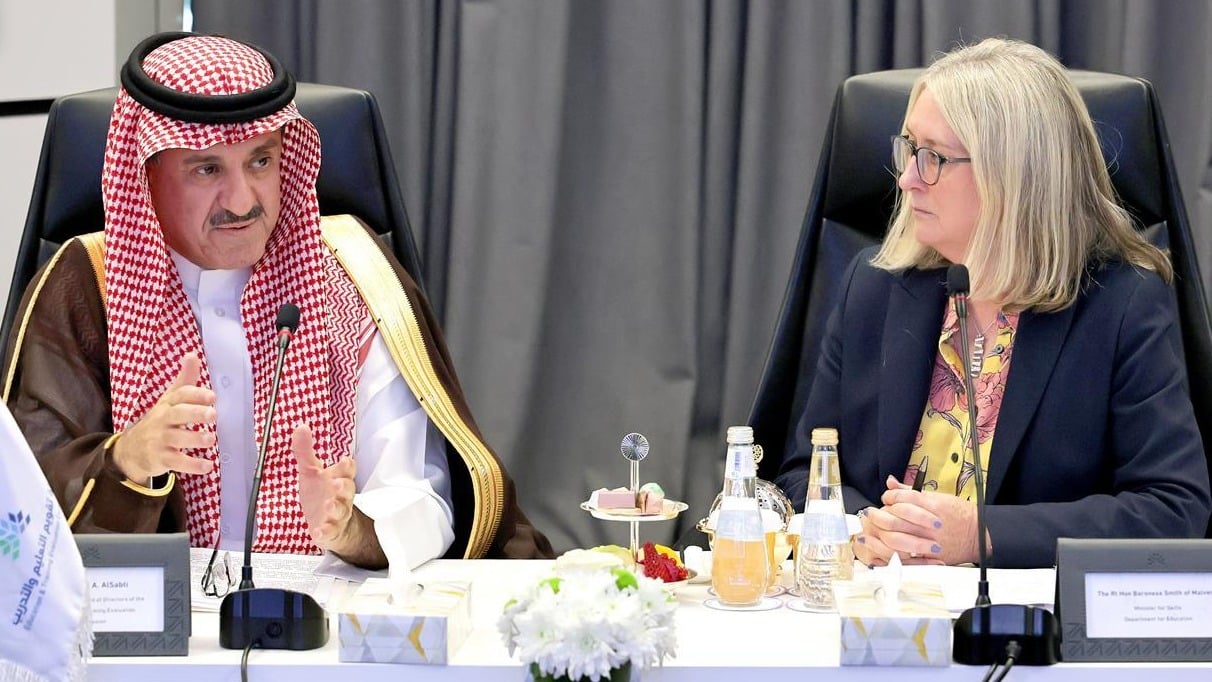
AIThe United Kingdom's Minister of State for Skills and member of the House of Lords, Baroness Jacqui Smith, has praised Saudi Arabia’s model for ensuring and regulating the quality of education and training, highlighting the Kingdom’s progress in leveraging data to support educational quality, drive continuous improvement, and inform evidence-based decision-making.
Her remarks came during a visit to the headquarters of the Education and Training Evaluation Commission in Riyadh, where she met with the commission’s chairman, Dr. Khaled bin Abdullah Al-Sabti. Baroness Smith was briefed on the commission’s mechanisms for collecting and analyzing data from the education and training sector, and how these are transformed into indicators that support evaluation, improvement, and decision-making processes.
Baroness Smith expressed her admiration for the commission’s capabilities, emphasizing that the true value of data goes beyond performance measurement to underpin ongoing improvement and help educational institutions identify strengths and opportunities for development. She described what she saw as “exceptionally impressive.”
The minister also stressed the importance of strengthening cooperation and sharing expertise between Saudi Arabia and the United Kingdom in education, skills, and quality, and developing links between relevant institutions to support the development of skills needed for labor market demands and the future economy.
Education and Training Situation Room and the commission’s experience
During her visit, the British minister was introduced to the Education and Training Situation Room, an advanced platform for reviewing and analyzing education and training data and connecting related indicators. This enables a comprehensive understanding of the education system, supports evaluation and decision-making, and improves outcomes.
She noted that the UK education system could benefit from the Saudi commission’s experience in the effective and precise use of data.
International recognition of the Saudi model
This recognition reflects the achievements of the Saudi model for ensuring and regulating the quality of education and training, particularly through the Education and Training Situation Room, which provides accurate data and advanced analytical capabilities to drive continuous improvement and tangible impact.
In the same context, the Education and Training Evaluation Commission presented its experience with the Situation Room as part of the Human Capital Network knowledge exchange series organized by the World Bank Group, with participation from representatives of around 100 countries and in coordination with the Ministry of Economy and Planning.
This comes as part of the transformation underway in Saudi Arabia’s education and training evaluation system, which integrates evaluation, measurement, accreditation, and data, and uses evaluation results for continuous improvement in line with the goals of Saudi Vision 2030, human capital development, and enhancing workforce readiness for the future.
The World Bank has previously commended Saudi Arabia’s efforts to develop its education system and the Saudi model for building and implementing evaluation, measurement, and accreditation systems using technology and data. The bank also highlighted the integration between the national “Nafis” tests and the National Program for School Evaluation, Classification, and Accreditation, as well as the promotion of a culture of excellence and continuous improvement at the school level.