Saudi Energy announces new electricity tariffs from January 2027
Saudi Energy has unveiled revised electricity tariffs for all sectors, introducing fixed monthly fees and new consumption rates effective January 1, 2027.

Key Takeaways
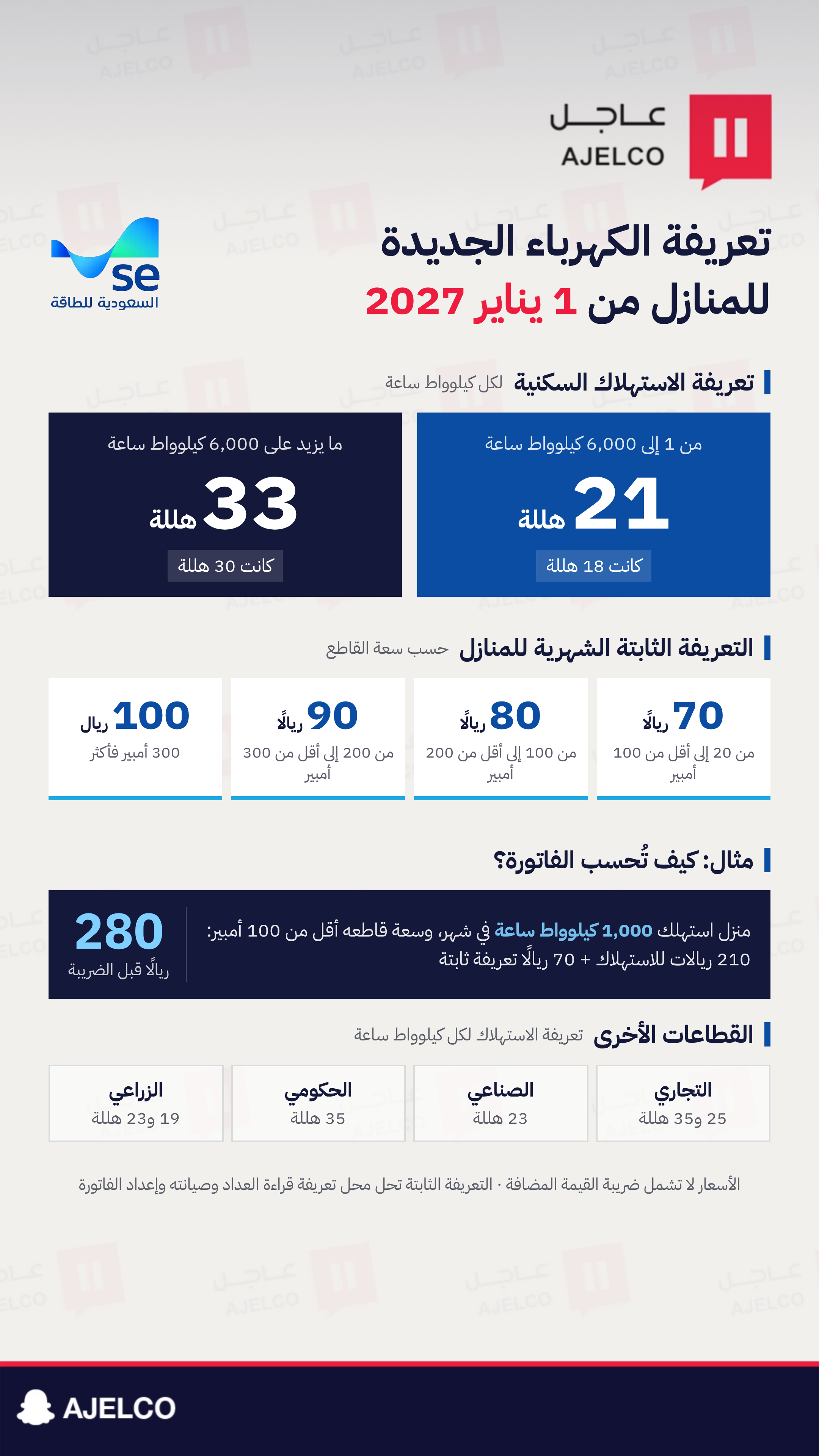
AISaudi Energy (formerly Saudi Electricity Company) has announced revised electricity service tariffs for all consumption categories, set to take effect on January 1, 2027. The new structure consists of two components: a fixed monthly tariff based on the approved circuit breaker capacity for each meter, and a consumption tariff calculated according to monthly electricity usage in kilowatt-hours.
In a guide published for subscribers, the company explained that the 'fixed tariff' will replace the previous 'meter reading, maintenance, and billing fee' across all sectors. The new bill will include both the consumption tariff and the fixed tariff. The announced prices do not include value-added tax, which will be added to the bill.
Residential sector
For residential customers, the consumption tariff is set at 21 halalas per kilowatt-hour for usage from 1 to 6,000 kilowatt-hours per month, and 33 halalas for usage above 6,000 kilowatt-hours, with the consumption brackets remaining unchanged.
The fixed monthly tariff for homes is 70 riyals for circuit breaker capacities from 20 to less than 100 amperes, 80 riyals for 100 to less than 200 amperes, 90 riyals for 200 to less than 300 amperes, and 100 riyals for 300 amperes or more.
Commercial, private health, and private educational establishments
The changes move private health facilities, institutions, and private schools into the commercial consumption category. For this group, the consumption tariff is 25 halalas per kilowatt-hour up to 6,000 kilowatt-hours, and 35 halalas for higher usage.
Industrial and government sectors
The consumption tariff for the industrial sector connected to the electricity transmission or distribution network is set at 23 halalas per kilowatt-hour for all usage, while the government sector will be charged 35 halalas per kilowatt-hour in a single bracket.
The fixed tariff for the commercial, industrial, government, private health, and private educational sectors is unified: 350 riyals per month for circuit breakers from 20 to less than 100 amperes, 500 riyals for 100 to less than 200 amperes, 700 riyals for 200 to less than 300 amperes, and 900 riyals for 300 amperes or more.
Agricultural sector and charities
The agricultural sector will pay a consumption tariff of 19 halalas up to 6,000 kilowatt-hours and 23 halalas for higher usage. Charities will pay 17 halalas and 21 halalas for the same brackets. The fixed tariff for both sectors is set at 140, 160, 180, and 200 riyals per month, depending on the four circuit breaker capacity categories.
How is the bill calculated?
The company stated that the fixed tariff is calculated proportionally to the number of days in the billing period if it is longer or shorter than 30 days, according to the following formula:
Fixed tariff × number of bill days ÷ 30.
It added that consumption before January 1, 2027, will be billed under the old tariffs, while consumption from that date will be billed under the new tariffs. As a result, the first bill after the new tariffs take effect may include charges under both the old and new rates if the consumption period spans both dates.
Based on the announced prices, a residential customer who consumes 1,000 kilowatt-hours in 30 days with a circuit breaker below 100 amperes will pay a bill of 280 riyals before VAT: 210 riyals for consumption and 70 riyals as the fixed tariff.
The company noted that customers can check their approved circuit breaker capacity through their account on the Saudi Energy app or via their monthly bill. It clarified that the breaker capacity determines the maximum electrical load that can be used simultaneously, but increasing capacity does not necessarily mean higher consumption, nor does reducing it guarantee lower usage.
The residential tariff in place since January 2018 has been about 18 halalas per kilowatt-hour for usage up to 6,000 kilowatt-hours per month, and 30 halalas for higher usage. The new tariff therefore represents an increase of 3 halalas per kilowatt-hour in both brackets.