

Spy scandal and election setback overshadow Trump’s Asia visit
US President Donald Trump heads to Asia amid a Republican midterm defeat and Chinese espionage allegations, raising stakes for talks with Xi Jinping.
Key Takeaways
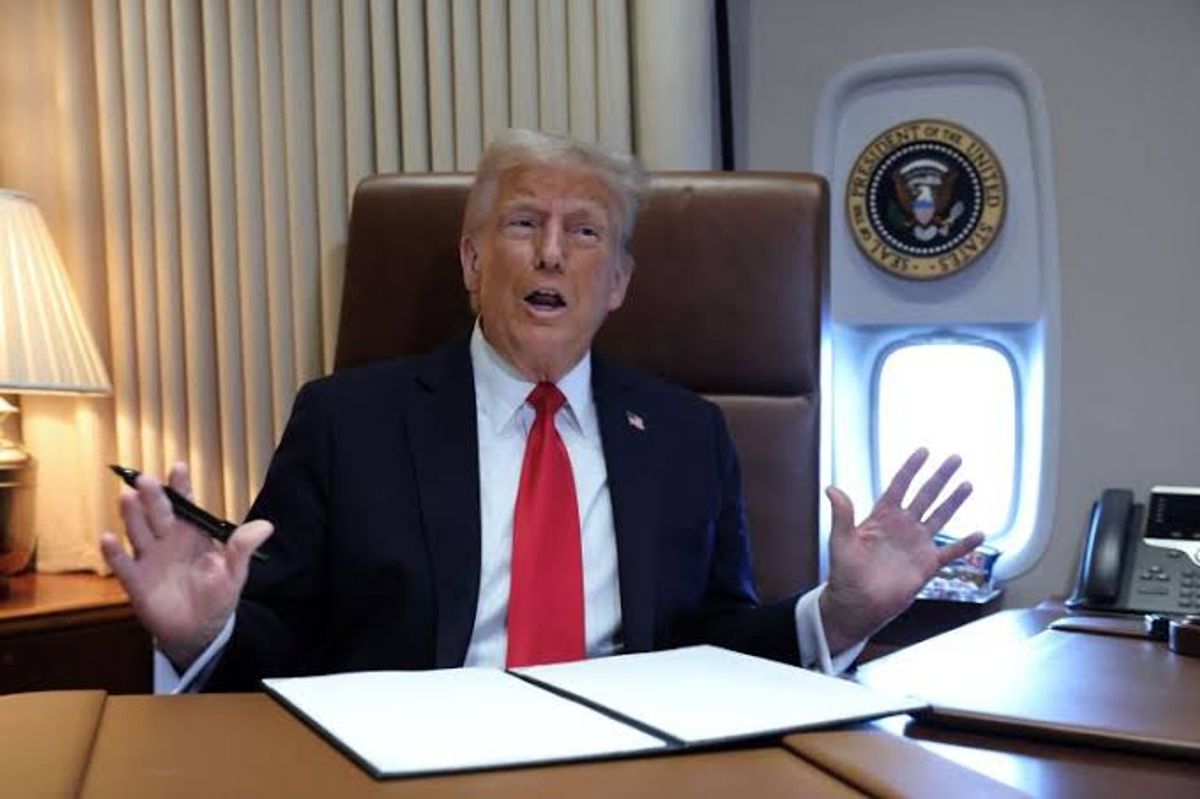
AIUS President Donald Trump departed for Asia on Monday, shortly after his Republican Party suffered a heavy defeat in the midterm congressional elections and amid allegations of suspected Chinese espionage—factors that heighten the sensitivity of his upcoming meeting with Chinese President Xi Jinping.
Speaking as he left the White House, Trump said he might also meet North Korean leader Kim Jong Un in China, a surprise announcement that could reshape his Asian tour if it materializes.
Trump is scheduled to travel first to Manila for meetings with Southeast Asian and other regional leaders on Tuesday, before heading to Shenzhen, China, to attend the Asia-Pacific Economic Cooperation (APEC) forum. There, he will meet President Xi and hold trilateral talks with Russian President Vladimir Putin.
Trump said he would discuss nuclear disarmament and the wars in Iran and Ukraine during his meeting with Putin and Xi, as well as trade and economic issues.
He added, "We might meet with Kim Jong Un as well... He might come. I don't know. It's up to President Xi."
During his first term (2017-2021), Trump met the North Korean leader several times and repeatedly expressed interest in another meeting, though he also referred to meetings that did not take place during last year’s Asia trip.
North Korea has publicly indicated it has no intention of meeting the US president at this time, and its UN mission has not responded to requests for comment.
Analysts had previously predicted that the Shenzhen summit would yield few concrete results, following the extension of a fragile trade war truce between the US and China into early next year, and with further Trump-Xi talks expected in December at the G20 summit in Miami.
However, those expectations shifted after the Republican Party’s losses in this month’s midterm elections and criticism of Trump’s administration for not taking adequate action following intelligence reports that Nvidia CEO Jensen Huang, who has close ties to Trump, had an affair with a woman suspected of being a Chinese spy.
Chinese analysts say there are concerns in China that the Nvidia case, involving allegations of restricted semiconductors being transferred to Chinese clients, will now prompt tougher US stances toward China.
Ruby Osman, China policy adviser at the London-based Tony Blair Institute, said, "With concerns about market reactions or electoral fallout fading, (Trump) may be more eager to consider drastic measures."
Washington had already signaled such intentions before the meeting, demanding China fulfill its commitments under the truce agreed by Trump and Xi a year ago.
US House Speaker Mike Johnson said last week there is growing consensus in Congress to impose further restrictions on China’s access to advanced chips following the scandal.
Democrats are expected to push hard on the issue when they take control of both the House and Senate in January.
Zhu Feng, director of the Institute of International Studies at Nanjing University, said the dispute could also accelerate a "decoupling" in artificial intelligence between the world’s two major powers, even as they try to cooperate to reduce the risks of these technologies.
China says the US fabricated the espionage story to justify a technological blockade.
A senior US administration official said the Nvidia case "should have little impact on the visit." Analysts believe Trump may want to focus on efforts to bolster his legacy.
Trump told reporters Monday he would not object to Huang returning as Nvidia CEO.
Trump sees the unprecedented summit with Xi and Putin as a potential catalyst for a nuclear arms control agreement. However, Chinese analysts say this is unlikely for China, which possesses far fewer warheads than other countries.
The proposed trilateral meeting has drawn comparisons, especially in Russia, to the 1945 Yalta Conference between the US, UK, and Soviet Union, which formalized spheres of influence and shaped the post-World War II order—becoming shorthand for great power deals imposed on smaller nations.
This prospect is of particular concern to Ukraine, which has been at war with Russia for four years.
The Kremlin said Monday that the meeting between Putin, Trump, and Xi would have a significant impact on global affairs.
Analysts say Xi may also seek to capitalize on Trump’s political vulnerability after his election defeat.
Beijing’s top priority is to ensure the US president does not approve a $14 billion arms deal for Taiwan, which China claims as its territory.
Kurt Tong, a former senior US State Department official now with the Asia Group think tank, said both leaders will also be keen to avoid reigniting a trade dispute that last year threatened to plunge the global economy and financial markets into chaos.
Despite US frustration over China’s implementation of the truce terms, Tong expects it to be extended again beyond its January 10 expiration.
Chim Lee, China affairs analyst at the Economist Intelligence Unit, said, "Both sides have a strong incentive to maintain this fragile stability... despite some differences between them... each has much to lose."