

Netanyahu threatens West Bank operation unprecedented since 1967 war
Israeli Prime Minister Benjamin Netanyahu says his government is considering a major military operation in the occupied West Bank after a deadly attack near Hebron.
Key Takeaways
AIIsraeli Prime Minister Benjamin Netanyahu announced that his government is considering launching a large-scale military operation in the occupied West Bank, which he said could be the first of its kind since the 1967 war. The operation would include evacuating residents from the neighborhood where the perpetrators of the Hebron attack originated and destroying its infrastructure, following the killing of two Israeli soldiers and the wounding of three others in a shooting at a military checkpoint near the city.
During a visit to Hebron after the attack, Netanyahu said Israeli forces "will enter the neighborhood from which the terrorists came, evacuate the residents, move from house to house, and destroy the terrorists' infrastructure," according to a statement from his office.
He added: "The defense minister and I are considering a large-scale military operation in Judea and Samaria [the term Israel uses for the occupied West Bank], the likes of which the region has not seen since the Six-Day War," referring to the 1967 conflict.
He continued: "The army is fully prepared to carry it out, and we will set its timing. It is being prepared."
Netanyahu indicated that Israeli forces in Hebron would follow the model of previous military operations in refugee camps in the northern West Bank. The "Iron Wall" operation, launched by the Israeli army in January 2025, displaced tens of thousands of Palestinians from the Jenin, Tulkarm, and Nur Shams camps.
Israel set to repeat Jenin camp model in Hebron
Israeli Defense Minister Yisrael Katz reinforced the move toward military operations and evacuations in Hebron, announcing that the model used in Jenin refugee camp would be applied to the city.
Katz said in a post on X on Friday, "The Jenin refugee camp model is on its way to Hebron."
He added: "Every neighborhood in Hebron from which the terrorists emerged today will be evacuated of its residents, and the terrorist infrastructure there will be dismantled."
Israeli forces continue to control the Jenin, Tulkarm, and Nur Shams refugee camps more than a year and a half after the start of the military operation. According to a report from the UN High Commissioner for Human Rights, as of July 2026, around 33,362 Palestinian refugees remained unable to return to their homes.
The three camps have witnessed widespread demolitions of homes and infrastructure. The Israeli army said the demolitions aim to create routes for forces and armored vehicles to move within the camps.
In Hebron, Israeli Finance Minister Bezalel Smotrich announced he had ordered the immediate demolition of numerous Palestinian structures near the attack site, describing them as "illegal." He said the demolitions would begin within an hour of the order and continue into the afternoon.
The Palestinian news agency WAFA reported that Israeli forces demolished a residential building with three apartments in the Farsh al-Hawa area west of Hebron, after closing off the area, its main entrance, and roads leading to the city.
Reuters also reported that Israeli bulldozers began demolishing homes near the shooting site, quoting residents who said the houses had no connection to the attackers.
Hebron attack leaves two Israeli soldiers dead
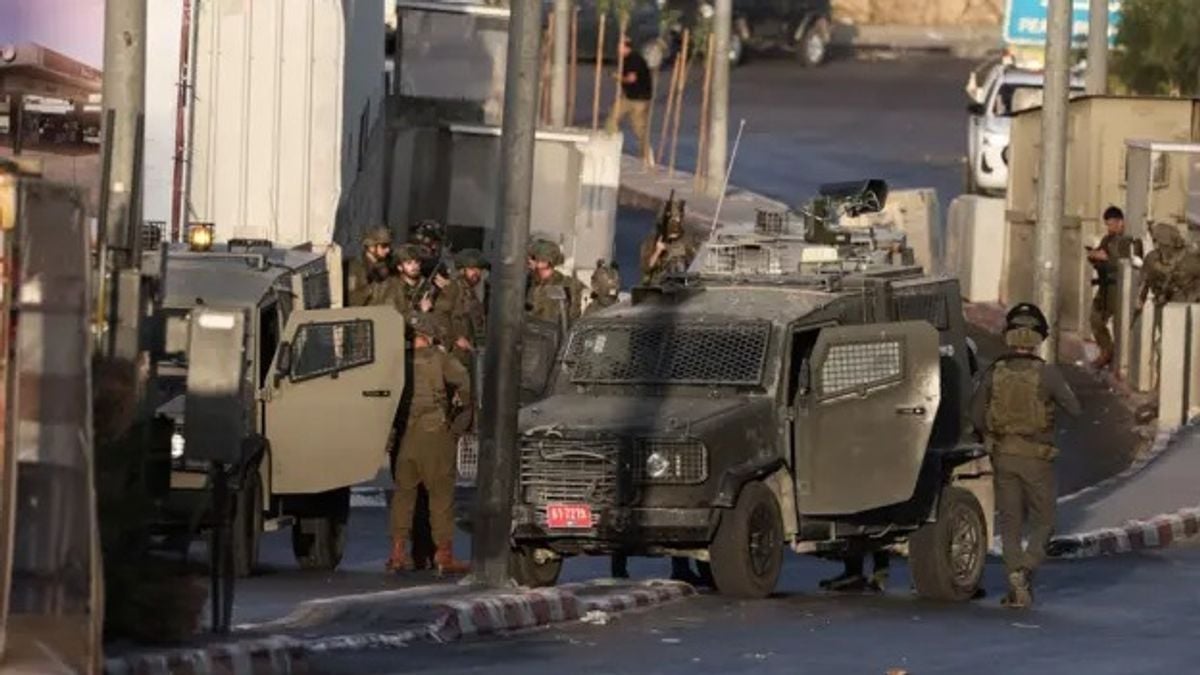
The Israeli threats followed a shooting attack at a military checkpoint near the Farsh al-Hawa area in Hebron, southern occupied West Bank, which killed two Israeli soldiers and wounded three others, according to the Israeli army.
Israeli medics had earlier reported at least five Israelis wounded, two of them seriously, before the army later confirmed two soldiers were killed and three others injured.
The Israeli army said its forces killed two Palestinians accused of carrying out the attack after an exchange of fire lasting about 20 minutes. It added that it believed the gunmen were planning a larger attack targeting civilians, but did not specify whether they acted alone or as part of a wider network.
Israeli forces immediately imposed a security cordon on Hebron and several nearby villages, conducting searches and raids on the homes of the two gunmen as well as other suspects.
Netanyahu also ordered preparations to completely seal off the West Bank, announcing that Israeli forces had thwarted what he described as a "large-scale attack."
In a statement from his office, he said: "We will pursue Hamas terrorists and those behind them everywhere and at all times. There is no safe place for you."
Meanwhile, the Palestinian news agency WAFA reported that Israeli forces tightened military measures at most entrances and exits to West Bank governorates, closing many checkpoints and iron gates in the south, center, and north of the West Bank.
Eli Bin, director general of Israel's Magen David Adom emergency service, said the wounded suffered gunshot injuries and received first aid from emergency teams and soldiers at the scene. Video footage published by medics and carried by AFP showed the body of a civilian-clothed individual lying near a gas station amid a heavy Israeli military presence.
The Palestinian Ma'an news agency reported that Israeli forces sent reinforcements to the area and imposed a security cordon on several nearby villages as search operations continued.
Smotrich and Ben-Gvir call for dismantling Palestinian Authority
Israeli reactions were not limited to threats of a major military operation. Finance Minister Bezalel Smotrich called for a military campaign in the occupied West Bank similar to Israeli operations in Gaza and Lebanon.
Smotrich, who also holds responsibilities in the defense ministry, said: "There is no other option but to launch a comprehensive military campaign to dismantle the Palestinian Authority, collect weapons, and eliminate terrorists, just as in Gaza and Lebanon."
He added: "In the next government, this should be one of the first steps we demand and implement."
Meanwhile, National Security Minister Itamar Ben-Gvir called for dismantling the Palestinian Authority, disarming it, and eliminating its infrastructure, warning of a new confrontation in the West Bank.
Ben-Gvir said in a statement: "We must not wait for another October 7 attack in the West Bank. That is where the next war will erupt."
He added: "We must act before it is too late. The Palestinian Authority must be dismantled and disarmed, and its terrorist infrastructure completely destroyed."
Hamas calls Hebron attack a 'heroic operation'
For its part, Hamas described the attack as a "heroic operation" in a statement published on a Telegram account attributed to the group, without claiming responsibility.
The group said the attack was "a natural and legitimate response to the ongoing crimes and brutal assaults against our people, land, and holy sites in the West Bank and occupied Jerusalem, and the continued aggression against our people in Gaza," according to the statement.
Hamas called on Palestinians in West Bank cities, villages, and camps to "fully mobilize" and escalate confrontations with Israeli forces and settlers, affirming its commitment to "the path of resistance and rejection of occupation," and vowing that Palestinians would not lay down their arms until the aggression ends and the occupation is over.
These developments come ahead of Israel's general elections scheduled for October 27, in which Netanyahu and his right-wing allies are campaigning on expanding West Bank settlements and opposing a Palestinian state.
Following the attack, Netanyahu ordered the Likud party to cancel all its scheduled political activities on Friday morning. The party said in a statement that the decision came after what it described as the "serious" attack at the Yehuda junction.