

Targeting of Mokha port exposes Houthi campaign against Yemen’s resources, says Al-Alimi
Yemeni Presidential Leadership Council chief Rashad Al-Alimi says the attack on Mokha port highlights a systematic Houthi assault on the country’s assets.
Key Takeaways
AIYemeni Presidential Leadership Council chairman Rashad Al-Alimi said that the targeting of Mokha port, following days of attacks on armed forces sites, displaced persons camps, civilian facilities, and attempts to strike ships and national infrastructure, demonstrates that the Houthi militia is waging a systematic war against Yemen’s resources, lifelines, and economic gateways.
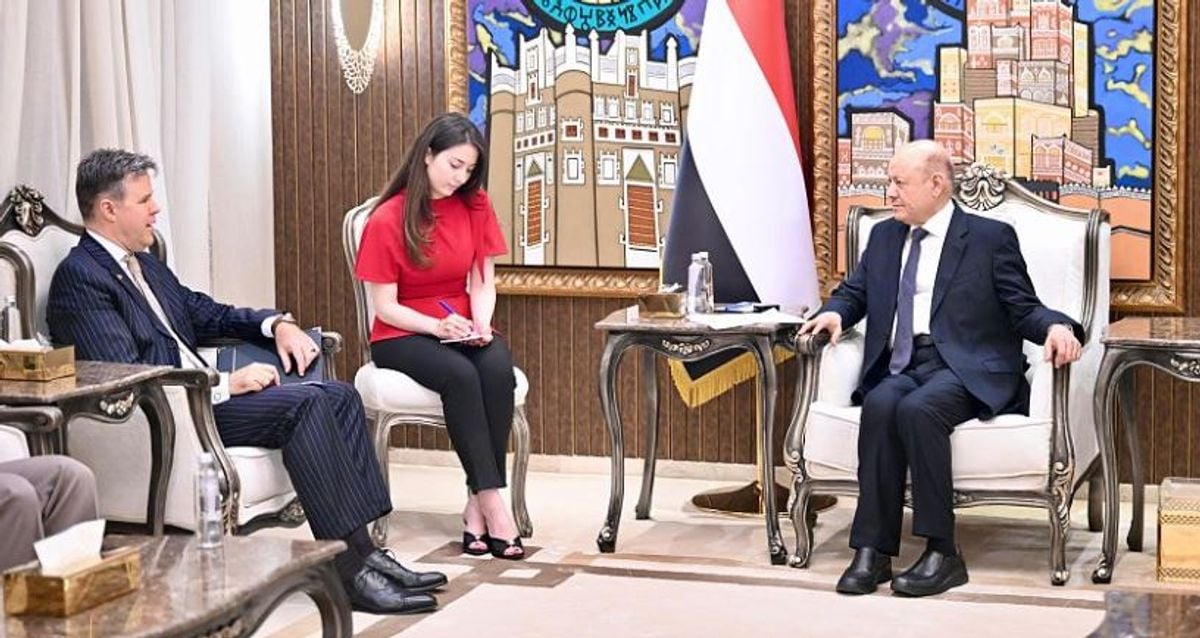
During a meeting on Sunday with Neil Hop, the US chargé d’affaires to Yemen, to discuss the strong bilateral relations and prospects for further cooperation, Al-Alimi added that the Houthis, who claim there is a blockade on areas under their control, are themselves targeting ports, airports, and economic facilities, threatening commercial vessels and supplies of food and fuel in an attempt to strangle the Yemeni people and worsen their humanitarian suffering.
According to Yemen’s Saba news agency, Al-Alimi stressed that the attack on a vital seaport near Bab Al-Mandab is part of an ongoing Iranian escalation targeting economic infrastructure, maritime routes, and the interests of regional countries, and again highlights the danger of advanced missiles, drones, and weaponry remaining outside state control.
Al-Alimi emphasized that this escalation places a clear responsibility on the international community, especially the United States, to protect Yemenis’ right to safe access to their ports, airports, and critical infrastructure, and to move beyond merely containing the Houthi threat by addressing its sources and tools, as well as supporting Yemeni state institutions and their ability to safeguard territory, waters, and citizens’ interests.
He explained that recent developments in the region once again confirm that the problem does not lie in isolated crises, but in a single source of instability—armed groups operating outside state institutions to pursue cross-border agendas.
Al-Alimi reiterated the government’s support for any diplomatic effort that eases tensions and prevents wars in the region, but warned that any agreements that do not clearly and sustainably address the threat posed by Iranian-backed militias, their military capabilities, funding, and threats to neighboring countries, will merely postpone the crisis rather than resolve it.
He stressed that lasting security in the region cannot be achieved while armed groups retain the ability to wage war, launch missiles and drones, and threaten international shipping lanes independently of state institutions and sovereignty.
The council chairman noted that recent events underscore the dangers of armed groups continuing to possess cross-border capabilities, and that protecting civilian and economic infrastructure and maritime routes is a shared regional and international responsibility.
Al-Alimi recalled that the Yemeni government has made significant concessions for many years to alleviate citizens’ suffering, while the militias have continued to develop their military capabilities, threaten cities and sea lanes, undermine state institutions, and increasingly tie Yemen to the Iranian regime’s agenda, stressing that the group does not see peace as a goal, but as an opportunity to reposition itself.
He insisted that the Houthis should not be rewarded through blackmail after failing to achieve their aims by force, and that any regional agreements must ultimately result in national states with exclusive control over legitimate means of force and constitutional institutions representing all citizens.
Al-Alimi said that recent developments on the ground have proven that state institutions and armed forces have become more capable, cohesive, and coordinated, and that continued attacks will not go without political and military consequences.