

Arab League chief tells Guterres: Palestinian state recognition must lead to concrete steps to end occupation
Arab League Secretary-General Nabil Fahmy discussed regional escalation and Palestinian statehood with UN Secretary-General Antonio Guterres in New York.
Key Takeaways
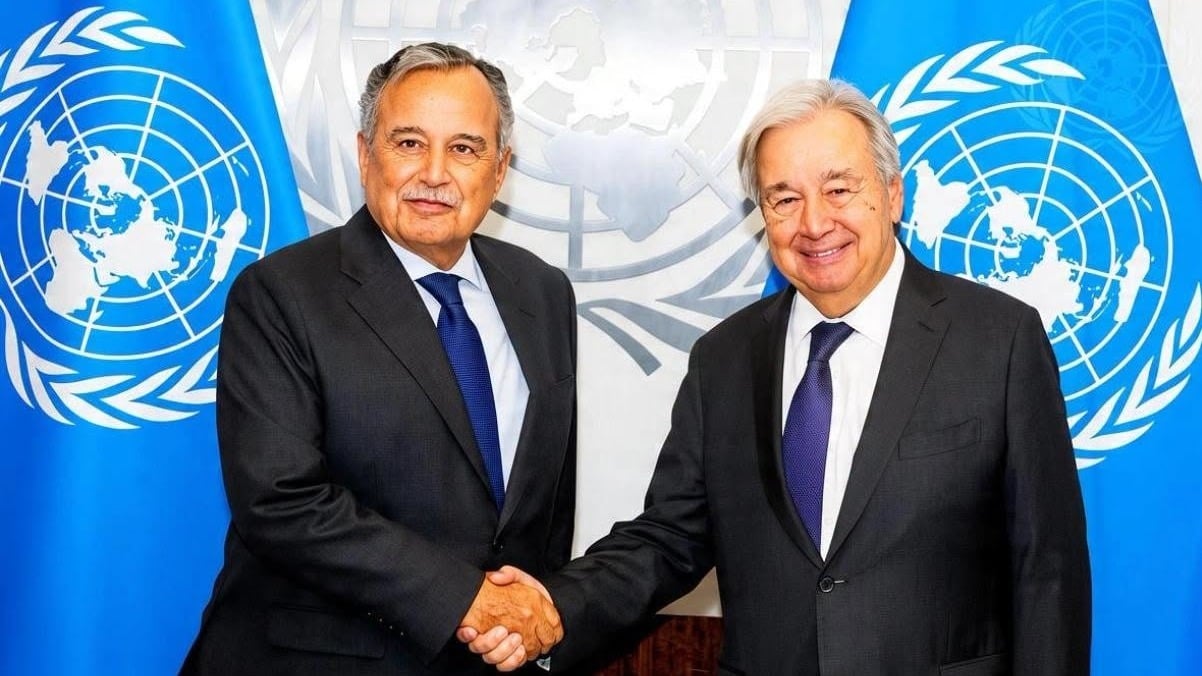
AIArab League Secretary-General Nabil Fahmy met with United Nations Secretary-General Antonio Guterres to discuss the serious escalation in the region, at the start of Fahmy’s participation in the high-level segment of the 81st session of the UN General Assembly in New York.
According to a statement from the Arab League’s General Secretariat on Monday, the meeting reviewed the impact of this escalation on the security and stability of the Arab region, as well as on international navigation, energy security, and global trade.
Fahmy reaffirmed the Arab League’s solidarity with its member states in safeguarding their security, sovereignty, and the integrity of their vital facilities. He stressed that freedom of navigation in the Strait of Hormuz and the Red Sea is a fundamental principle of international law that must not be compromised under any pretext.
Both sides agreed that containing the escalation requires serious international action that addresses its root causes, rather than merely managing its consequences. The meeting also addressed the situation in the occupied Palestinian territories, particularly the humanitarian crisis in Gaza and the increasing Israeli violations in the West Bank and occupied Jerusalem.
Fahmy emphasized the need to hold Israel accountable to international law and international humanitarian law, and stated that broad international recognition of the Palestinian state must be followed by concrete steps to end the occupation and establish an independent state along the June 5, 1967 borders with East Jerusalem as its capital. He affirmed that Gaza is an integral part of the occupied Palestinian territories and that any arrangements separating it from the West Bank are unacceptable.
The two officials also discussed developments in Syria, Lebanon, Yemen, and Libya, as well as the grave situation in Sudan, which threatens further humanitarian deterioration. They renewed their call for an immediate ceasefire and the opening of safe corridors for aid delivery to alleviate the suffering of the Sudanese people and halt the worsening humanitarian crisis.
Both sides praised the strong partnership between the United Nations and the Arab League, describing it as a model for cooperation between international and regional organizations. They stressed the importance of continued effective coordination between the two bodies on regional and international issues to help achieve peace and stability in the Arab region and beyond.