
Iraq to shift US ties toward economic partnership, says PM Zaidi
Iraq is entering a new phase in its relations with the US and coalition partners, as Prime Minister Ali Faleh Zaidi stresses state authority over peace and war.
Key Takeaways
AI
Iraq is entering a new phase in its relations with the United States and the international coalition, as the government’s September 30 deadline approaches for transitioning toward long-term economic cooperation. This comes as Prime Minister Ali Faleh Zaidi affirms Baghdad’s commitment to strengthening state sovereignty, consolidating arms under government control, and developing the country’s military and defense capabilities.
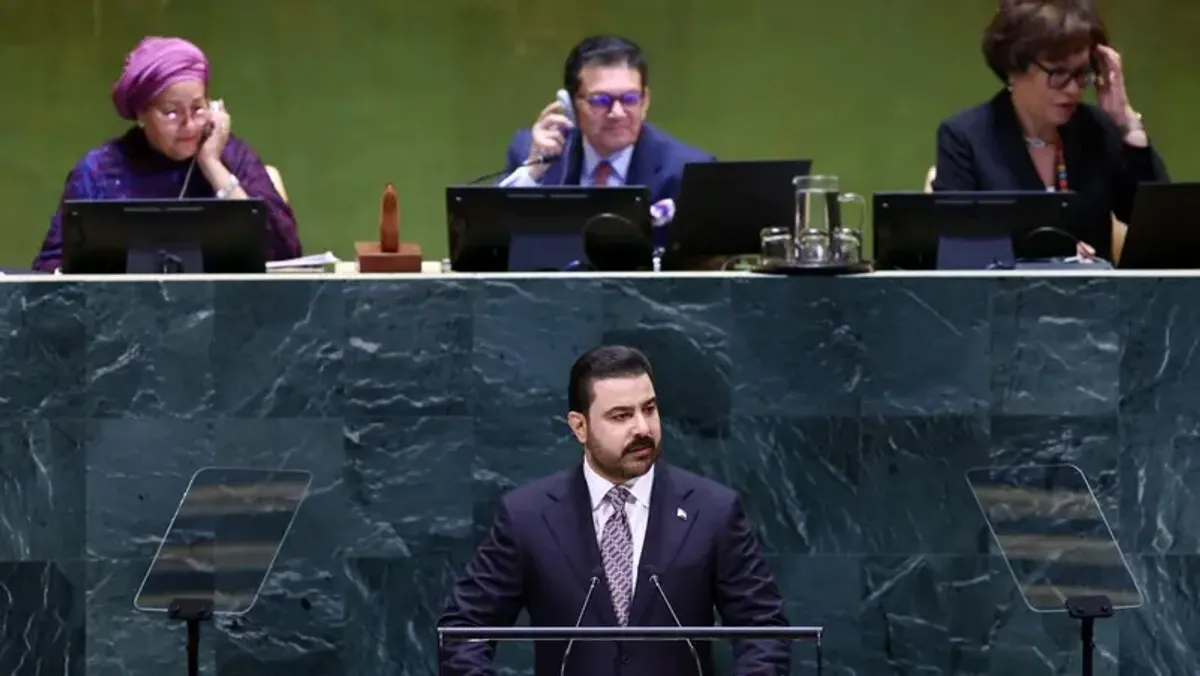
Speaking at the 81st session of the United Nations General Assembly in New York, Zaidi said Iraq would shift “from military to economic cooperation” with the end of the coalition’s mission. Before his trip to New York, the government had announced that September 30 would mark a turning point in relations with Washington, paving the way for long-term economic partnership.
Coinciding with this transition, the prime minister emphasized that decisions of peace and war must remain the exclusive prerogative of the state. He stressed that his government’s vision “is rooted in restoring the rule of law and strengthening state institutions,” adding that efforts to consolidate arms under state control “are on the right track.” Zaidi reiterated that Baghdad is determined for the state to be “the sole authority in matters of peace and war.”
Zaidi linked this approach to reinforcing state institutions and building Iraq’s military and defense capacity, as well as securing borders and addressing gaps that could foster extremism. He also highlighted the government’s ongoing “battle against corruption and efforts to protect public funds,” and its drive to build a strong state and a modern, diversified economy.
On the economic front, the prime minister explained that Iraq’s vision is based on its resources and investment opportunities. Baghdad has developed a roadmap to support the private sector and aims to shift from being vulnerable to crises to becoming “an active regional partner.” The government had previously announced that Zaidi would address economic reform, income diversification, anti-corruption, investment openness, and affirmation of national sovereignty during his visit to New York.
While in the United States, Zaidi participated in a meeting with the American Chamber of Commerce, inviting companies to invest in Iraq. He also discussed strengthening economic and investment ties with several countries in New York.
In the energy sector, Zaidi stated that Iraq aspires to become “a global center for energy production,” and is working to diversify oil export routes to ensure access to global markets. He also expressed Baghdad’s “deep concern” over threats to freedom of navigation and maritime transport amid regional tensions.
Politically, Zaidi reaffirmed Iraq’s commitment to the UN Charter, recalling the country’s experience with wars and their consequences. He stressed that “sustaining peace is a shared responsibility, and stability cannot be achieved through war.” He added that Iraq, having “endured many wars and their aftermath,” seeks to serve as “a bridge for dialogue and cooperation among the region’s peoples.”
The prime minister reiterated Baghdad’s support for dialogue and diplomacy to defuse crises and resolve conflicts through negotiation, stating that Iraq aims to move the region “from conflict to integration” and extends its hand to all neighbors on the basis of good relations.
Zaidi’s meetings on the sidelines of the General Assembly carried the same message, including his talks with Iranian parliamentarian Masoud Pezeshkian, where both sides emphasized the need to prevent further escalation and spare the region additional crises.