

Yemen human rights ministry reports 3,334 Houthi violations in 15 provinces, 594 civilians killed in three months
Yemen’s human rights ministry has documented 3,334 Houthi violations in 15 provinces from August to mid-November 2026, including 594 civilian deaths.
Key Takeaways
AI
The Yemeni Ministry of Human Rights has documented 3,334 violations committed by Houthi militias across 15 provinces between August 1 and November 15, 2026. These included the killing of 594 civilians and the injury of 1,255 others, as well as abductions, child recruitment, and attacks on homes, schools, and health facilities amid escalating violence and increasing restrictions on the movement of people and supplies.
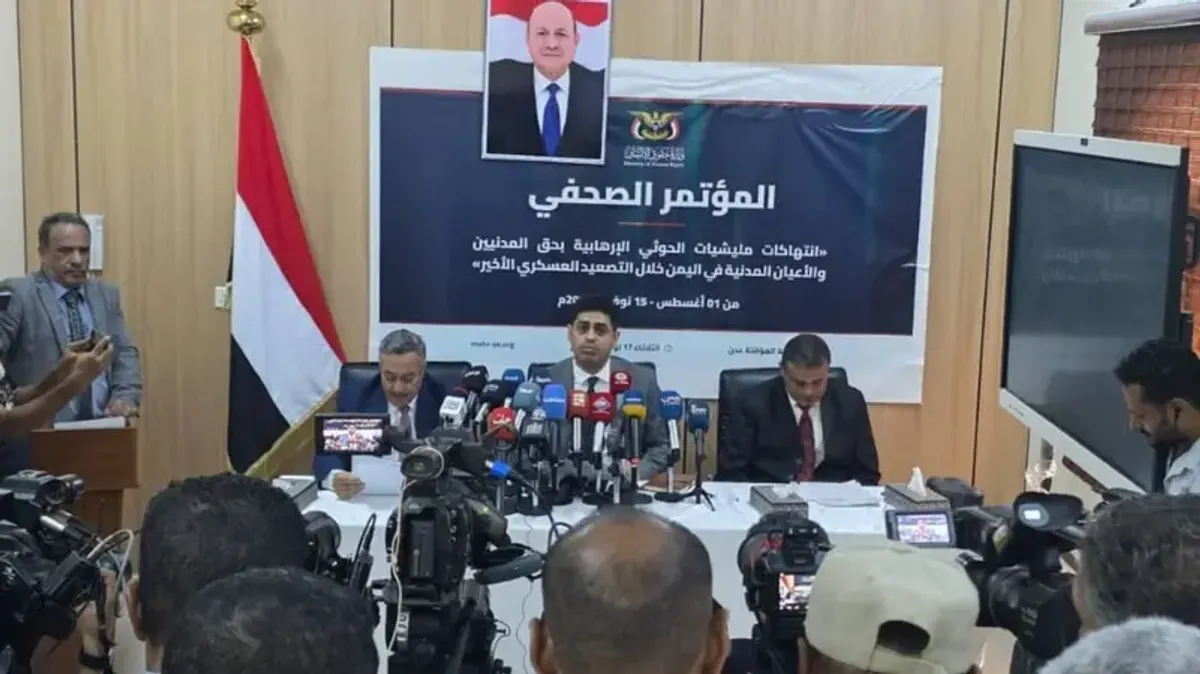
During a press conference in the interim capital Aden on Tuesday, the ministry presented a report detailing violations it attributed to missile and artillery strikes, drone attacks, and landmines. The report said these targeted residential neighborhoods, markets, displacement sites, public and private property, and water sources.
According to the report, the total number of civilian casualties reached 1,849, including 196 women, 215 children, and more than 80 elderly people. The ministry documented 127 cases of extrajudicial killings, as well as 233 cases of abduction, arbitrary detention, and enforced disappearance. Of these, 25 cases were identified by name, while 208 were part of mass campaigns targeting students, educators, activists, and humanitarian workers.
Missiles, drones, and attacks on infrastructure
The report recorded the recruitment of 260 children and their deployment to frontlines, attacks on 412 homes and shelters, and 93 educational facilities that were bombed, stormed, or used for military purposes. This led to the closure of 243 schools and deprived more than 137,000 students of education.
In the health sector, the ministry documented 517 violations affecting health centers, hospitals, ambulances, and medical warehouses. There were also 19 attacks on buildings, mosques, archaeological, historical, cultural, and religious sites.
The report noted 53 ballistic missile attacks, with at least 121 missiles launched, and the use of 137 attack and suicide drones, in addition to explosive devices and artillery shells. The attacks were concentrated in the Marib, Taiz, Lahj, Dhale, Shabwa, and Hadramout fronts, targeting military sites, residential areas, and vital roads.
The list of attacks included the targeting of Al-Naseem camp in Marib on August 7, sites for displaced people in Raghwan and Mafraq Harb in September, the shelling of Wadi Al-Qadi in Taiz on September 24, and the Al-Hadara market in Al-Waziya on November 5.
Taiz: road closures, disrupted supplies, and displacement
The report dedicated a section to the escalation in Taiz, noting continued Houthi attacks since September 3 on the western and southwestern parts of the province. These targeted supply lines linked to the western coast and southern provinces, resulting in the closure of vital roads and disruption of civilian movement and goods transport.
It documented the bombing of a water crossing under the Hejah Al-Abd road on October 1, followed by another explosion on October 18, which blocked the passage of food, fuel, gas, and humanitarian aid trucks. The report also noted road closures and the establishment of illegal checkpoints in Jabal Habashi, hindering the delivery of drinking water tankers from the Dhabab wells.
The report cited a United Nations announcement on November 2 that all roads leading to Taiz city had been closed due to fighting, halting the arrival of regular commercial supplies. At the same time, more than 130 trucks loaded with essential goods were stranded in the Al-Farsha area north of Lahj.
According to the International Organization for Migration, about 18,780 people—representing 3,130 families—were displaced between November 8 and 14. The ministry warned of the loss of shelter and livelihoods, psychological distress, and the risks of repeated displacement.
The ministry called for national and international action to protect civilians, end violations, and ensure humanitarian aid reaches those affected.