

Yemen urges UN action to halt Houthi violations against children
Yemen’s government has called on the UN for urgent international measures to stop Houthi abuses against children, citing widespread recruitment and attacks.
Key Takeaways
AIThe Yemeni government has sent a letter to United Nations Secretary-General Antonio Guterres, Security Council President Sanita Pavluta-Deslandes, and UNICEF, urging urgent international action to stop violations it accuses Houthi militias of committing against children. The letter calls for exposing the scale of recruitment, killings, and targeting of children amid escalating military operations and worsening humanitarian conditions in the country.
The letter, delivered by Yemen’s Permanent Representative to the UN, Ambassador Abdullah Al-Saadi, coincided with World Children’s Day. It cited figures from the Ministry of Human Rights covering August 1 to November 15, 2026, documenting 3,334 violations against civilians and civilian sites in 15 provinces. Among the victims were 215 children killed or wounded, and 260 child recruits killed after being sent to the front lines by Houthi forces.
According to the Yemeni government, these figures highlight the range of violations children face, including not only death and injury but also recruitment, exploitation, abduction, and detention. Many are also deprived of education and healthcare as the conflict continues and displacement rises.
260 child recruits killed; schools and summer camps used for recruitment
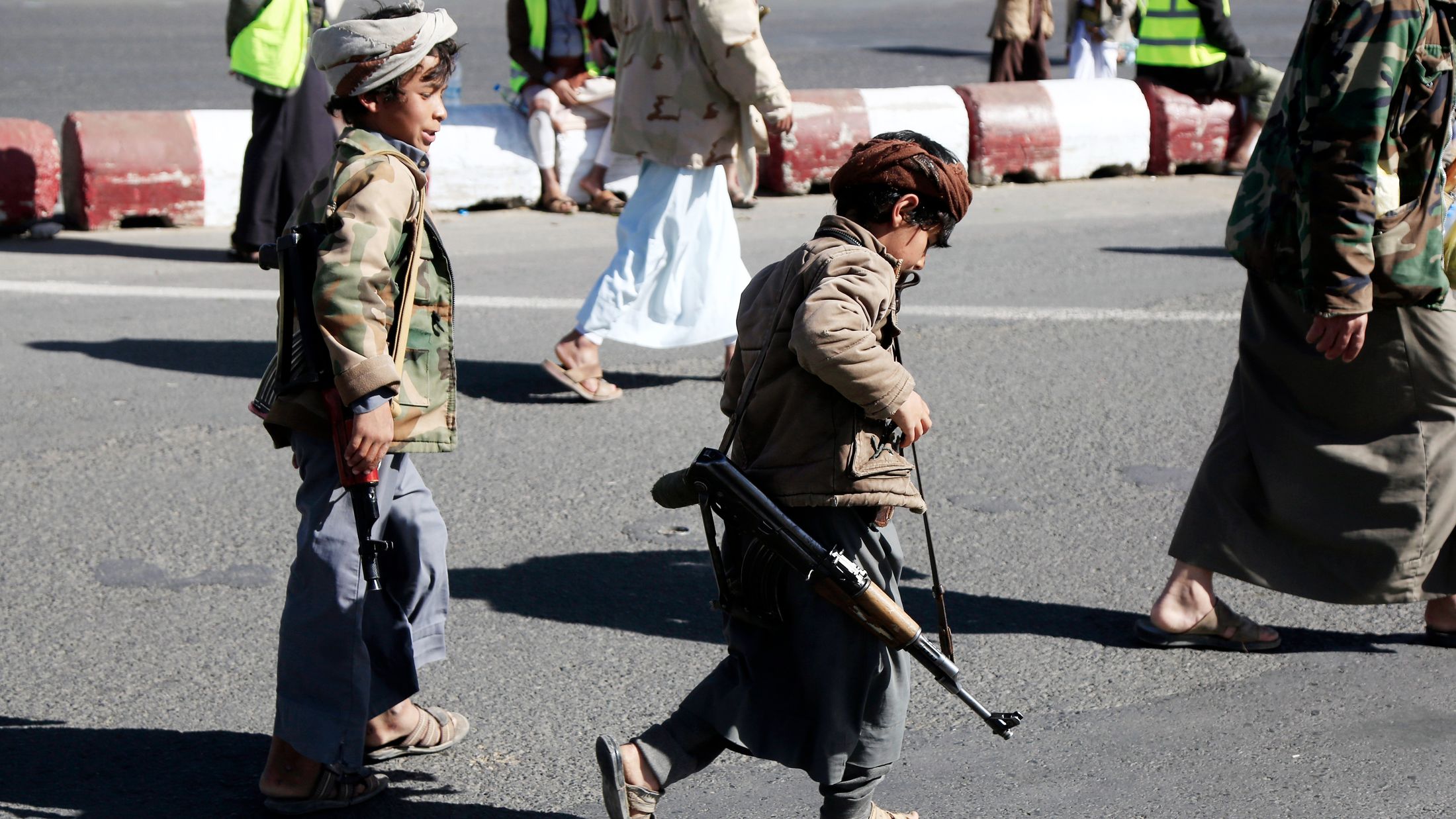
The government revealed that the Ministry of Human Rights documented the deaths of 260 children recruited and deployed to combat by Houthi militias. Recruitment methods reportedly include exploiting school environments, social pressure on families, and the use of summer camps and cultural or religious activities for indoctrination and enlistment.
The letter stressed that such practices expose children to direct danger and deprive them of basic rights, calling for urgent measures to end their recruitment, exploitation, and involvement in hostilities.
The government based its appeal on the Convention on the Rights of the Child, especially Articles 38 and 39, and the Optional Protocol on the involvement of children in armed conflict, which requires steps to prevent child recruitment, demobilize child soldiers, and reintegrate them into society.
Shelling in Marib and Taiz: children among the dead and wounded
The letter detailed incidents documented by the Ministry of Human Rights, including attacks on residential areas and displacement sites that resulted in child casualties.
In Marib province, Houthi shelling of a displacement site in Ragwan district on September 8, 2026, killed two children aged 5 and 7 and injured 15 civilians, including eight children.
In Taiz province, the ministry recorded the deaths of three children in the village of Al-Turaira on September 17: Nour Al-Din Yaqub Abdo Al-Zurafi, Asawar Fahd Mohammed Ghanem Al-Zurafi, and Tala Mohammed Ahmed Al-Zurafi.
Further shelling in the Wadi Al-Qadi neighborhood of Taiz on September 24 killed three-year-old Amir Issam Ahmed Naji Ghaleb and wounded five others.
The letter said these incidents reflect the dangers children face from attacks on residential and displacement areas, which violate principles of distinction, proportionality, and precaution in protecting civilians.
93 educational facilities targeted; classes suspended in 243 schools
Beyond casualties, the government reported that the Ministry of Human Rights documented 93 educational facilities targeted or damaged by shelling, raids, or misuse. Classes were suspended in 243 schools due to restrictions and military escalation, affecting over 137,000 students.
Incidents included attacks on Karim School in Al-Wazi’iyah district, Taiz, on September 3, 2026, and Amr bin Al-As Secondary School in Al-Malabiyah, Al-Mudarabah and Ras Al-Arah district, Lahj, on September 23.
The attack on Amr bin Al-As School killed three civilians and wounded four, causing extensive damage to a facility sheltering displaced families.
The ministry also documented shelling of Al-Suqia Primary School in Lahj on October 5, and the targeting of Ahmed bin Hanbal School in Al-Ruwais, Al-Mahawilah, on October 10, which destroyed the building entirely.
In Taiz, ongoing attacks on residential areas and those near schools led to the suspension of classes in 29 schools in Jabal Habashi district.
The government warned that targeting educational facilities deprives thousands of children of their right to education and increases risks of dropout, exploitation, and recruitment, as well as psychological and social harm from losing a safe learning environment.
517 violations against the health sector; children denied vaccinations
In the health sector, the government said the Ministry of Human Rights documented 517 violations against health facilities and services, including hospitals, clinics, health centers, medicine warehouses, and ambulances.
It noted that targeting or disrupting these facilities hampers the health system’s ability to provide essential services, making it harder for children and families to access medical care, medicines, and nutrition, especially in areas affected by military escalation.
The government also warned of the consequences of blocking vaccination campaigns and restricting vaccine delivery to Houthi-controlled areas, which deprives children of essential immunizations and raises the risk of outbreaks of diseases such as polio and measles.
The government called for lifting restrictions on immunization campaigns and ensuring vaccines reach all children, considering immunization an essential service for their health and safety.
Children detained in Al-Bayda; 233 cases of abduction, detention, and enforced disappearance
On detentions, the letter revealed that the Ministry of Human Rights documented the arrest of at least 28 people in Al-Bayda province on September 29, 2026, most of them children aged 13 to 14, with some transferred to a Houthi detention center in Rada’a city.
The ministry also recorded 233 cases of abduction, arbitrary detention, and enforced disappearance, including 25 individually documented cases and 208 in mass campaigns, affecting various civilians, including children.
The government warned that these practices violate legal safeguards protecting children from arbitrary deprivation of liberty and expose them to abuse, enforced disappearance, and loss of contact with their families.
347,000 displaced in just over three months
The Yemeni government linked the rise in violations against children to worsening humanitarian conditions, continued attacks on residential and displacement sites, movement restrictions, limited humanitarian access, and the siege of Taiz city.
Citing International Organization for Migration data as of November 14, 2026, the letter reported 347,321 people displaced since early August, with Taiz hosting the largest number at 143,130, followed by Lahj with 91,314 and Aden with 70,404.
The government noted that children are among the most affected by displacement, facing food insecurity, disrupted education and health services, and greater needs for shelter, water, and social protection.
It warned that these conditions increase risks of exploitation, recruitment, and school dropout, as well as long-term psychological and social impacts from displacement and loss of a safe family and educational environment.
What Yemen’s government asked of the United Nations
The Yemeni government called on the United Nations, Security Council, and UNICEF to take urgent steps to strengthen child protection and pressure for an end to violations and accountability for perpetrators.
Its main demands included:
Enhancing mechanisms for monitoring, verifying, and reporting grave violations against children, in coordination with the UN Secretary-General’s Special Representative for Children and Armed Conflict.
Requiring the Houthis to stop recruiting and using children in hostilities, demobilize child soldiers, and ensure their rehabilitation and reintegration.
Releasing children held arbitrarily and complying with the Optional Protocol to the Convention on the Rights of the Child on the involvement of children in armed conflict.
Respecting international humanitarian law and protecting civilians and civilian sites, including schools and hospitals, and refraining from their military use or targeting.
Supporting national institutions in documenting violations, providing psychological and social rehabilitation, and ensuring continued education and healthcare for affected children.
The government also stressed the need for full and effective implementation of Security Council resolutions on Yemen, especially Resolutions 2140 (2014), 2216 (2015), and 2837 (2026). It said implementation would help curb Houthi attacks, strengthen civilian protection, and end impunity. The Security Council adopted Resolution 2837 on November 12, 2026, as part of its Yemen sanctions regime.