
Syrian president appoints Mazloum Abdi as presidential adviser
Syrian President Ahmad Al-Shara has named Kurdish leader Mazloum Abdi as a presidential adviser, days after the dissolution of the Syrian Democratic Forces.
Key Takeaways
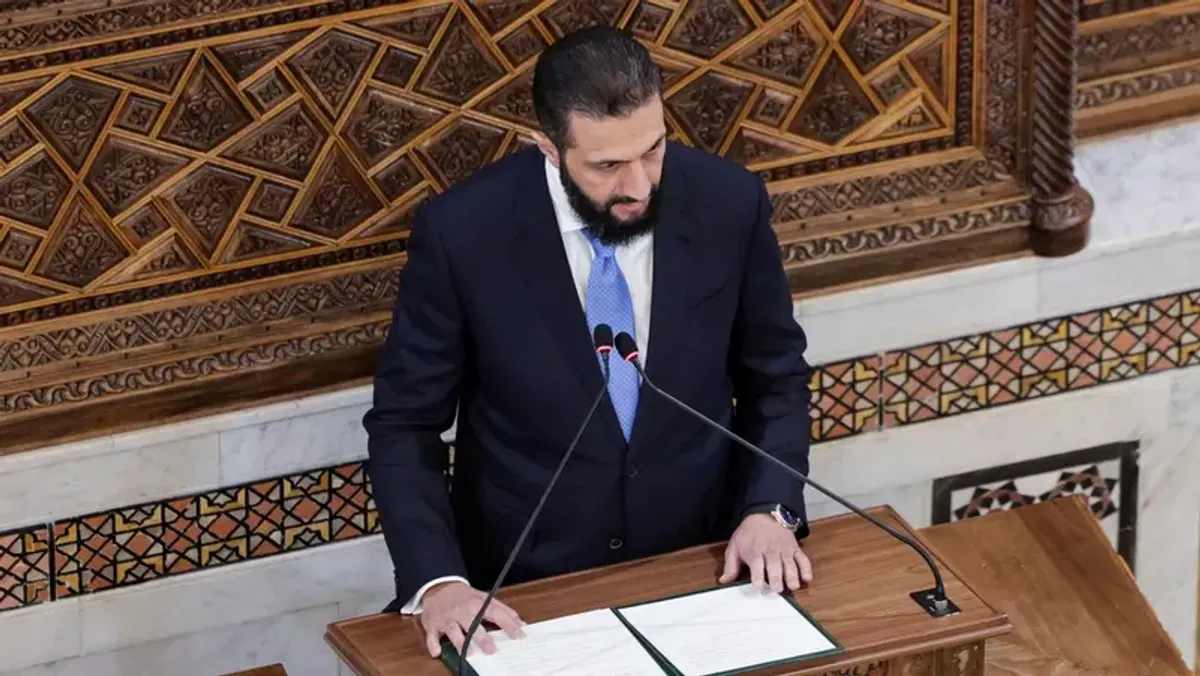
AISyrian President Ahmad Al-Shara on Friday appointed Mazloum Abdi as a presidential adviser, just days after the Kurdish leader announced the dissolution of the Syrian Democratic Forces as part of an agreement to integrate them into state institutions.
Meanwhile, Syria’s Ministry of Education announced it has approved the teaching of the Kurdish language in public and private schools, following an amendment to Decree No. 13 governing educational curricula.
The decree, signed by Al-Shara and published by the official SANA news agency, states: “Mustafa Khalil Abdi (Mazloum Abdi) is appointed as an adviser to the Presidency of the Republic.”
On Tuesday, Abdi announced the dissolution of the Syrian Democratic Forces, which he led, saying their “mission was complete.” The move marks a significant turning point for Syria’s Kurds and a major victory for Al-Shara.
With the dissolution of the Syrian Democratic Forces, a key chapter in the history of Syria’s Kurds comes to a close. Many had hoped to secure autonomy and preserve gains made during years of conflict, while the new Syrian authorities, since their arrival in Damascus, have insisted on national unity and restoring control over the entire country.
US Special Envoy for Syria and Ambassador to Turkey Tom Barak on Tuesday praised the decision to dissolve the Syrian Democratic Forces, calling it “historic.” He added that granting influential government roles to Kurdish figures, including Abdi, reflects recognition of the Kurds’ sacrifices and their contribution to regional stability.
For his part, Abdi said the dissolution of the SDF came after “the completion of the integration of our forces into the Syrian army brigades.”
Formed in 2015 with US support, the Syrian Democratic Forces served as the military arm of the Kurdish self-administration and spearheaded the fight against Daesh. However, shifting political dynamics and declining US support led them to reach understandings with Damascus.
Prior to the agreement, a military escalation forced the SDF to withdraw from large Arab-majority areas to its stronghold in Hasakah province. Syrian authorities then took over facilities previously controlled by the Kurds, including Qamishli airport and key oil and gas fields.
- Kurdish language education -
On January 16, Al-Shara issued a decree enshrining national rights for the Kurds and recognizing Kurdish as a national language—an unprecedented step since Syria’s independence in 1946.
On Thursday evening, the Ministry of Education announced that, under the revised curricula, Kurdish language instruction will be permitted in public and private schools “in areas where Kurdish citizens constitute a significant proportion of the population, at all educational levels,” alongside Arabic and English.
The decision allows students to “choose to study social studies, history, geography, and philosophy in either Arabic or Kurdish,” according to the decree.
Last week, Abdi announced the completion of the integration of the Kurdish administration into state institutions, affirming that “our struggle will continue to secure our people’s rights in the constitution.”
There are an estimated two million Kurds in Syria out of a population of about 20 million, with most residing in the northeast, as well as in Damascus and Aleppo.