

Mars, Jupiter and Regulus align before dawn Thursday as Orionid meteor shower peaks
A rare alignment of Mars, Jupiter and Regulus will be visible across the Arab world before dawn on October 22, coinciding with the Orionid meteor shower peak.
Key Takeaways
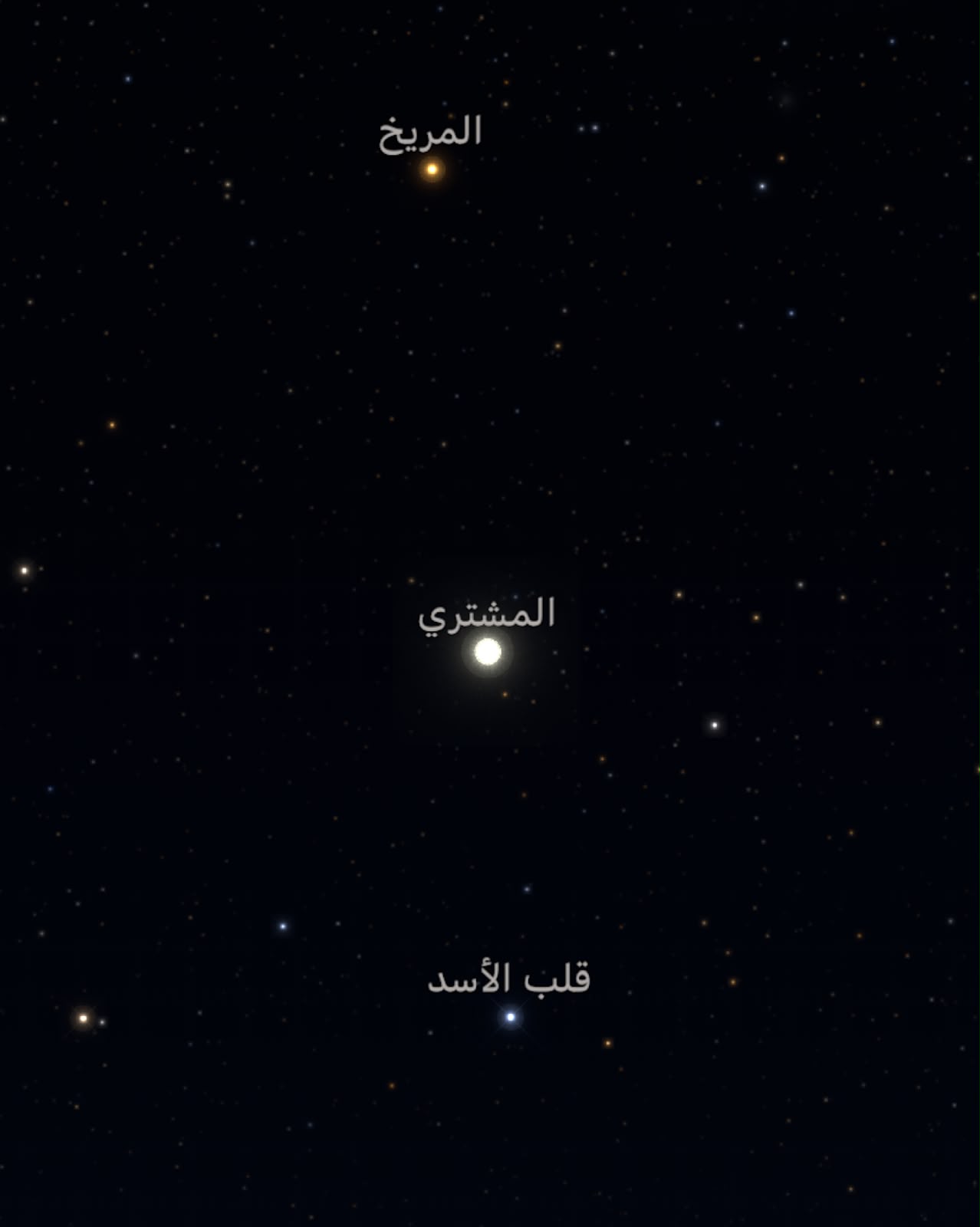
AIMajed Abu Zahira has announced that the skies over the Arab world will witness a remarkable astronomical event before dawn on Thursday, October 22, 2026: a visual alignment of Mars, Jupiter, and the star Regulus, coinciding with the peak of the Orionid meteor shower. He explained that this alignment offers an opportunity to observe these bright celestial bodies and watch meteors during the final hours of the night.
Abu Zahira noted that Mars will appear with its reddish-orange hue, Jupiter will shine bright white, and Regulus will be a prominent star with a blue-white tint. The apparent angular distance between Mars and Jupiter will be about 9 degrees, and between Jupiter and Regulus about 7 degrees, making the three objects seem aligned across the sky. He emphasized that this is only a visual alignment and does not mean the objects are physically in a straight line in space.
He added that the significance of this event increases as Mars and Jupiter continue to draw closer in the coming weeks, culminating in their conjunction on November 16, 2026, offering another opportunity for astronomical observation and photography.
This alignment coincides with the peak of the Orionid meteor shower on the night of Wednesday, October 21, and before dawn on Thursday, October 22. The meteors occur when Earth passes through a trail of dust particles left by Halley's Comet. As these particles enter the atmosphere at speeds of about 66 kilometers per second, they burn up and create the bright streaks known as meteors. Under ideal conditions, the theoretical rate is between 10 and 20 meteors per hour, though the actual number depends on sky clarity, light pollution, and the elevation of the shower's radiant above the horizon.
Abu Zahira pointed out that one of the main challenges for observation this year is the increasing brightness of the waxing gibbous moon, which may obscure fainter meteors for part of the night. The best viewing conditions will be after the moon sets and before the start of astronomical dawn, a window of about two and a half hours that varies by location and horizon clarity. He advised choosing a dark site away from city lights and allowing 20 to 30 minutes for eyes to adjust to the darkness.
He mentioned that Mars, Jupiter, and Regulus can all be seen with the naked eye, and that observing meteors does not require a telescope or binoculars. It is recommended to watch a wide area of the sky rather than focusing solely on the constellation Orion, as meteors can appear in various directions and often travel far from the shower's radiant point. This event serves as a reminder of the ever-changing nature of the night sky, combining the apparent motion of celestial bodies with the passage of Halley's Comet particles through Earth's atmosphere.