

Saudi Roads Authority classifies vehicle parking facilities into three main types
Saudi Roads Authority details new classification of parking facilities under the Saudi Roads Code to improve organization and efficiency.

Key Takeaways
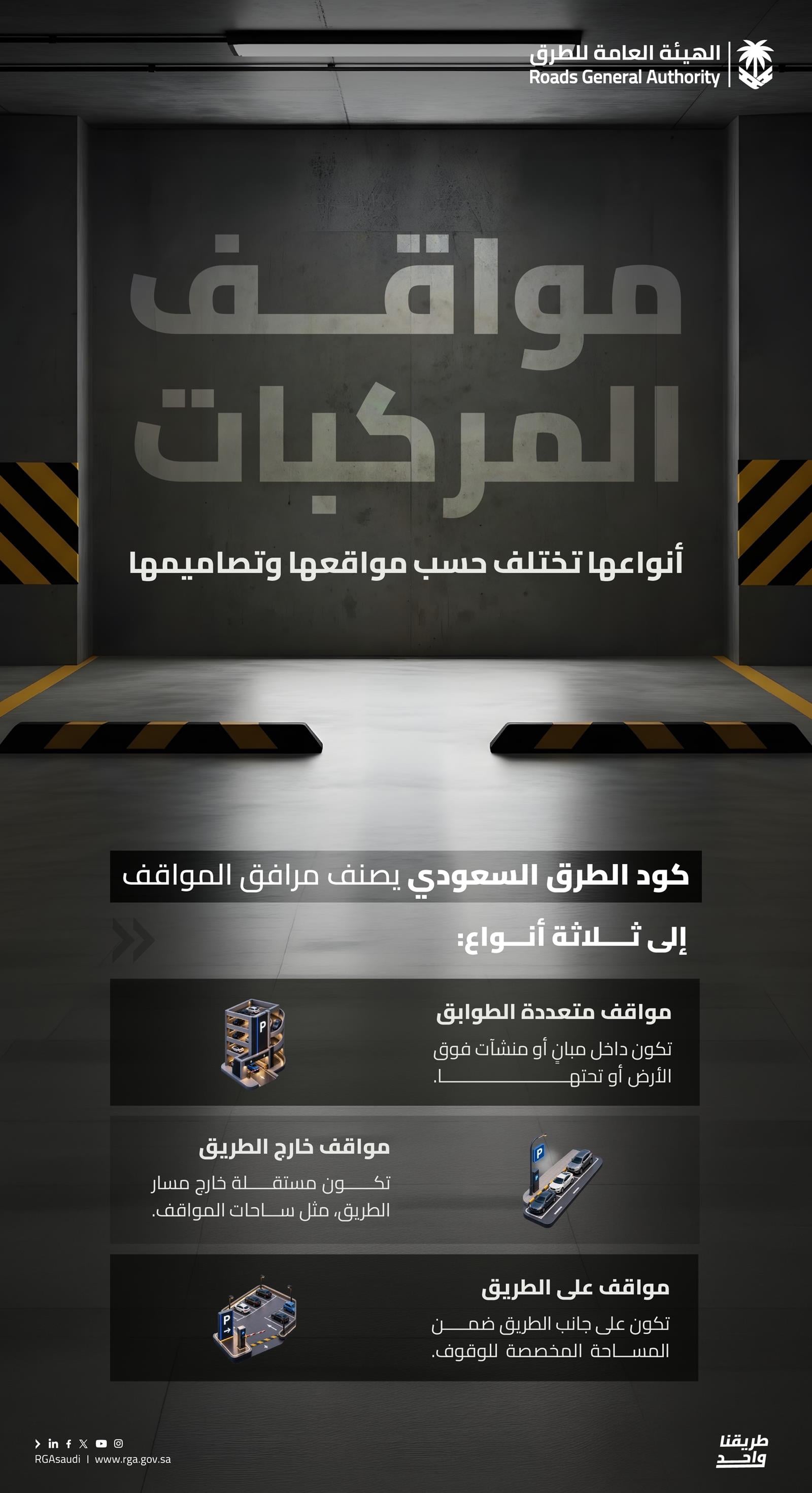
AIThe General Authority for Roads has announced that the Saudi Roads Code classifies vehicle parking facilities into three main types, based on their locations and designs, in order to better organize them and align their planning with the nature of roads, facilities, and user needs.
The authority explained that the classification includes on-street parking, which refers to spaces designated for vehicles along the sides of roads; off-street parking, which are independent facilities set away from the road, such as lots designed to accommodate vehicles outside the direct flow of traffic; and multi-storey parking, which are constructed within buildings or structures either above or below ground to provide organized parking spaces.
The authority emphasized that the Saudi Roads Code serves as a comprehensive technical reference for all entities responsible for the road sector in the Kingdom, including ministries, city development authorities, regional municipalities, and city and governorate municipalities. The code provides these bodies with access to information, guidelines, technical drawings, procedures, and checklists necessary for road planning, design, implementation, operation, and maintenance, while taking into account environmental requirements and safety standards to achieve quality, economic efficiency, and sustainability.
Enhancing the Kingdom’s road system
The authority noted that the Saudi Roads Code supports its strategy to establish a unified legislative and regulatory framework for the road sector by standardizing technical and operational criteria nationwide. This helps road-owning entities systematically and sustainably improve the quality of their work, with comprehensive standards covering the entire road lifecycle from design and construction to ongoing operation and maintenance.
The authority also affirmed its commitment to providing a unified and transparent legislative and regulatory system that ensures policy integration and regulatory compliance, through the application of flexible yet robust oversight mechanisms. It further highlighted ongoing efforts to expand the adoption of modern technical standards to enhance the experience of road users and achieve the highest levels of safety, efficiency, and sustainability, in line with the objectives of the Road Sector Program.