

Transport authority deploys robot to inspect culverts, boost road safety
The General Authority for Roads has launched an advanced robot to inspect culverts, aiming to enhance road maintenance, traffic safety, and infrastructure quality.

Key Takeaways
AIThe General Authority for Roads has launched an advanced robot to inspect culverts, as part of its ongoing efforts to improve road maintenance systems, asset evaluation, infrastructure quality, and road safety standards.
The authority explained that the robot is a state-of-the-art inspection device operating with closed-circuit television (CCTV) technology. It travels inside pipelines and culverts, equipped with high-resolution 4K cameras for both front and rear views, high-intensity auxiliary lighting, a distance-measuring device, and a portable control unit with an electric cable reel. This setup allows for precise documentation of the structural and operational condition of culverts.
The authority noted that the robot features advanced technical capabilities, including 360-degree rotation, 180-degree flipping, and an electric lift platform to adjust the camera height up to 260 mm. It also offers up to 10x zoom, autofocus, and sensors with resolutions between 2 and 4 megapixels for instant transmission of high-definition images to the control unit via tablet or laptop.
The authority confirmed that the robot is water-resistant to international standards and comes with three optional wheel sizes to ensure efficient operation in various culvert conditions. It can record video, capture images of defects, and accurately document their locations.
The authority added that the robot includes integrated software for automatic defect interpretation, detecting cracks, deformations, blockages, deposits, tears, and other issues. It generates professional inspection reports in real time, provides detailed analysis of inspection data, and supports online editing to create an accurate database for technical and operational decision-making.
The authority stated that this initiative enhances the use of advanced technologies in surveying, assessment, and maintenance, reduces the need for personnel to enter confined or high-risk environments, improves diagnostic accuracy, and accelerates preventive maintenance work.
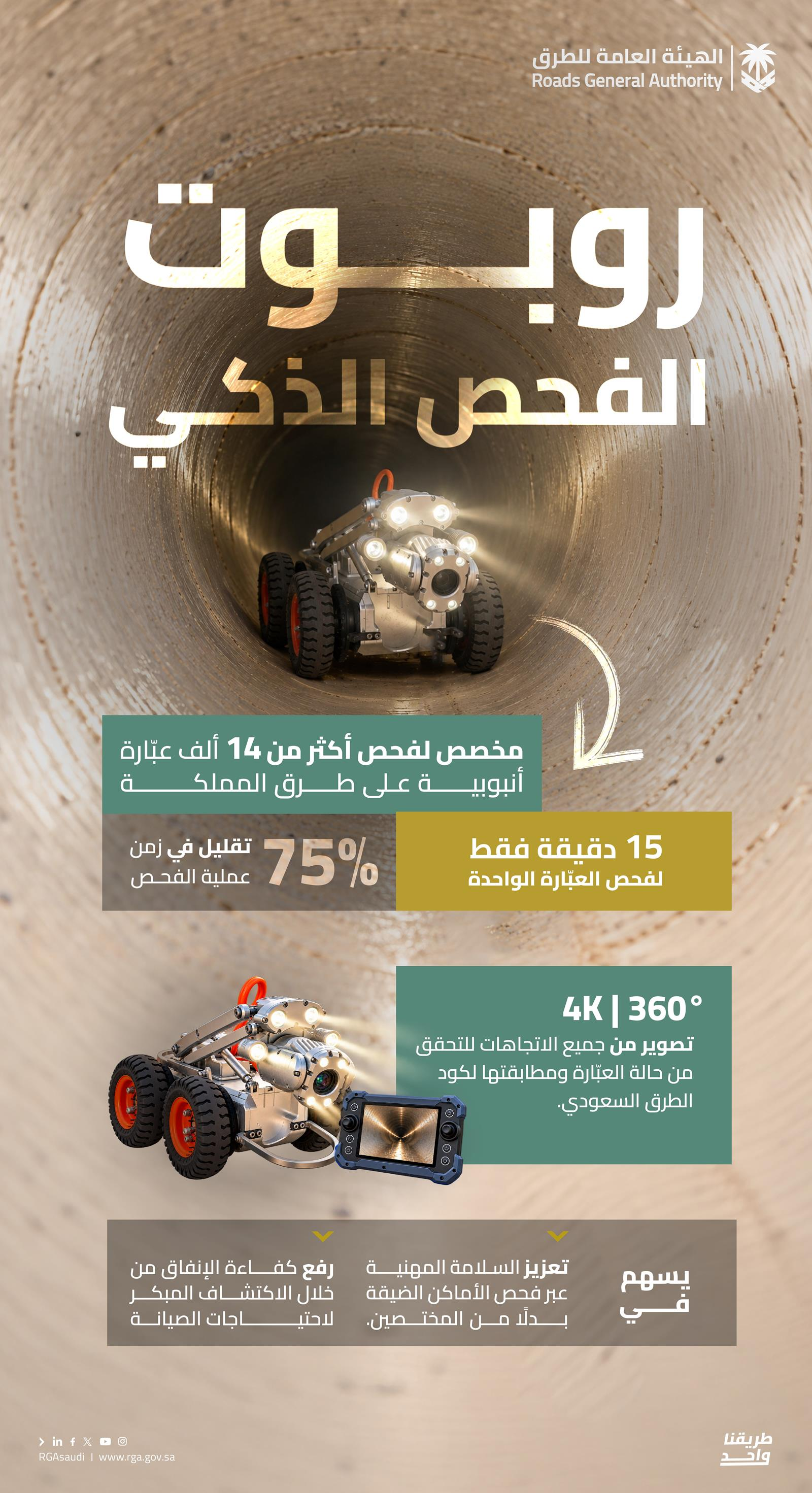
The authority concluded by reaffirming its commitment to implementing innovative projects and initiatives to develop the road sector, in line with the Road Sector Program’s goal of reducing road traffic fatalities to fewer than five per 100,000 people, ensuring the network meets international safety standards under the International Road Assessment Programme (IRAP), and maintaining network efficiency.