

Saudi Cabinet approves new patent law and 13 other decisions
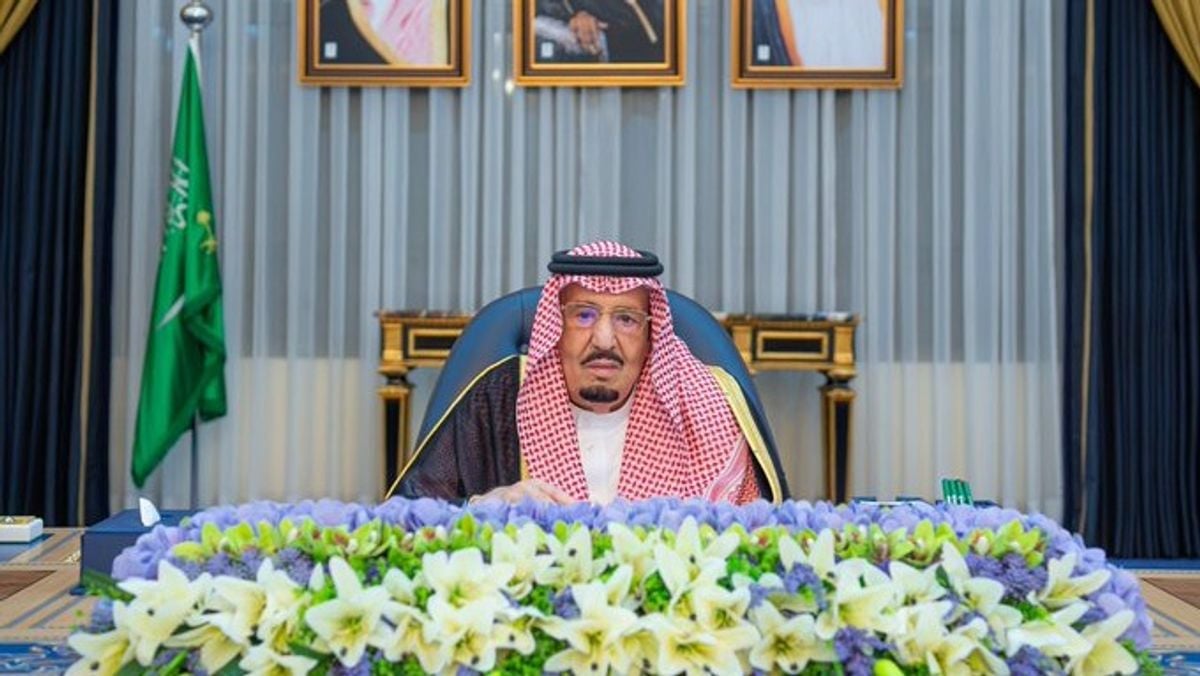
King Salman chaired the Cabinet meeting in Riyadh, which approved a new patent law and 13 other key decisions on regional, economic, and international matters.
Key Takeaways
AIKing Salman bin Abdulaziz chaired the Cabinet session held today in Riyadh.
At the start of the meeting, the Cabinet reviewed a message received by King Salman from Sheikh Tamim bin Hamad Al Thani, Emir of Qatar, as well as the recent meeting between Crown Prince Mohammed bin Salman, Prime Minister, and Iraqi Prime Minister Ali Faleh Al-Zaidi.
Minister of Media Salman bin Yousef Al-Dosari said in a statement to the Saudi Press Agency after the session that the Cabinet discussed the latest regional and international developments, and the Kingdom’s ongoing efforts to promote regional stability and mitigate the impact of conflicts and tensions on global energy security, international trade, supply chain sustainability, and maritime navigation—all of which require international cooperation to protect the global economy.
The Cabinet welcomed the presidential statement issued by members of the UN Security Council condemning the terrorist Houthi militia’s attacks on civilian sites, airports, and energy infrastructure in Saudi Arabia, as well as ongoing threats to navigation in the Red Sea and Bab Al-Mandab. The statement also emphasized the importance of fully implementing Security Council Resolution 2216 and subsequent resolutions, and called for practical cooperation to prevent the group from obtaining weapons and other support.
The Cabinet praised the decision by the Council of Foreign Ministers of the Organization of Islamic Cooperation to establish a "Council of Cybersecurity Ministers for OIC Member States" and to select Riyadh as the headquarters for its general secretariat and executive office. This initiative, proposed by Saudi Arabia, reflects the Kingdom’s commitment to strengthening cybersecurity and its track record in supporting strategic initiatives in this field.
The minister said the Cabinet discussed the outcomes of several international conferences hosted by Saudi Arabia, commending the recommendations of the Riyadh Economic Forum, which are expected to support the national economy, enhance economic policies, and strengthen public-private partnerships in line with the Kingdom’s development goals.
The Cabinet noted that foreign direct investment in Saudi Arabia is projected to grow by 33.5% in 2025 compared to 2024, underscoring the attractiveness of the Saudi economy, the effectiveness of recent economic and structural reforms, and the promising outlook under Vision 2030.
The Cabinet reviewed agenda items, including those studied in coordination with the Shura Council, as well as reports from the Political and Security Affairs Council, the Economic and Development Affairs Council, the General Committee of the Cabinet, and the Bureau of Experts. The Cabinet issued the following decisions:
First:
Approval of a headquarters agreement between the Saudi government and the United Nations Institute for Training and Research to open an office in the Kingdom, and a memorandum of understanding on cybersecurity between the National Cybersecurity Authority and the UN Institute’s office.
Second:
Authorizing the Chairman of the Nuclear and Radiological Regulatory Commission, or a delegate, to discuss and sign two draft memorandums of understanding with the Australian Radiation Protection and Nuclear Safety Agency and the Australian Safeguards and Non-Proliferation Office for cooperation on nuclear safety, radiation protection, nuclear security, and non-proliferation.
Third:
Authorizing the Minister of Tourism, or a delegate, to discuss and sign a draft memorandum of understanding for cooperation in tourism between the Saudi Ministry of Tourism and the Ministry of Tourism of Syria.
Fourth:
Approval of a memorandum of understanding between the General Department of Financial Investigation at the Presidency of State Security and the United Nations Office on Drugs and Crime.
Fifth:
Approval of a memorandum of understanding between the Saudi Food and Drug Authority and the State Institute of Drugs and Good Practices of the Russian Federation.
Sixth:
Approval of the Patent and Utility Models Law.
Seventh:
Approval of the New Plant Varieties Law.
Eighth:
Approval of the Integrated Circuit Layout Designs Law.
Ninth:
Approval of the Designs Law.
Tenth:
Allowing the spouse and children of employees assigned to work abroad, scholarship employees, and scholarship students to join educational missions for bachelor’s and master’s degrees, subject to certain regulations.
Eleventh:
Extension of the Sustainable Rural Agricultural Development Program until the end of 2032.
Twelfth:
Approval of the final accounts for Al-Baha University, Hafr Al-Batin University, and King Fahd National Library for two previous fiscal years.
Thirteenth:
Issuing directives regarding several agenda items, including annual reports from the Ministry of Human Resources and Social Development, the General Authority for Foreign Trade, the Saudi Standards, Metrology and Quality Organization, the Saudi Geological Survey, the Saudi Space Agency, the Saudi Press Agency, Saudi Post, the National Debt Management Center, the National Center for Performance Measurement of Public Entities, and the King Abdulaziz Foundation for Research and Archives.
Fourteenth:
Approval of the promotion of the following individuals to the rank of Minister Plenipotentiary at the Ministry of Foreign Affairs:
- Badr bin Abdulaziz Al-Mufaireej.
- Nabil bin Ahmed Al-Zahrani.
- Yahya bin Ahmed Akeesh.