
Saudi voluntary carbon market drives sustainable transition, supports low-carbon economy
Saudi Arabia’s voluntary carbon market achieves major milestones, advancing Vision 2030 and the Kingdom’s net-zero target by 2060.
Key Takeaways
AISaudi Arabia has emerged as a key player in shaping the future of carbon markets with the launch of the Regional Voluntary Carbon Market Company, an advanced platform that integrates climate action with economic development and supports the transition to a low-carbon economy in line with Vision 2030 and the Saudi and Middle East Green Initiatives.
The market aims to enable both public and private entities to trade certified carbon credits generated from projects that reduce or remove emissions from the atmosphere. This allows companies to offset hard-to-abate emissions while supporting environmental investments and sustainable projects.
Advanced platform and significant achievements
Fadi Saad, CEO of the Regional Voluntary Carbon Market Company, explained that the company was established in October 2022 as an initiative by the Public Investment Fund (80%) and Saudi Tadawul Group (20%), with the goal of developing a voluntary credit trading platform and accelerating the shift toward a more sustainable economy.
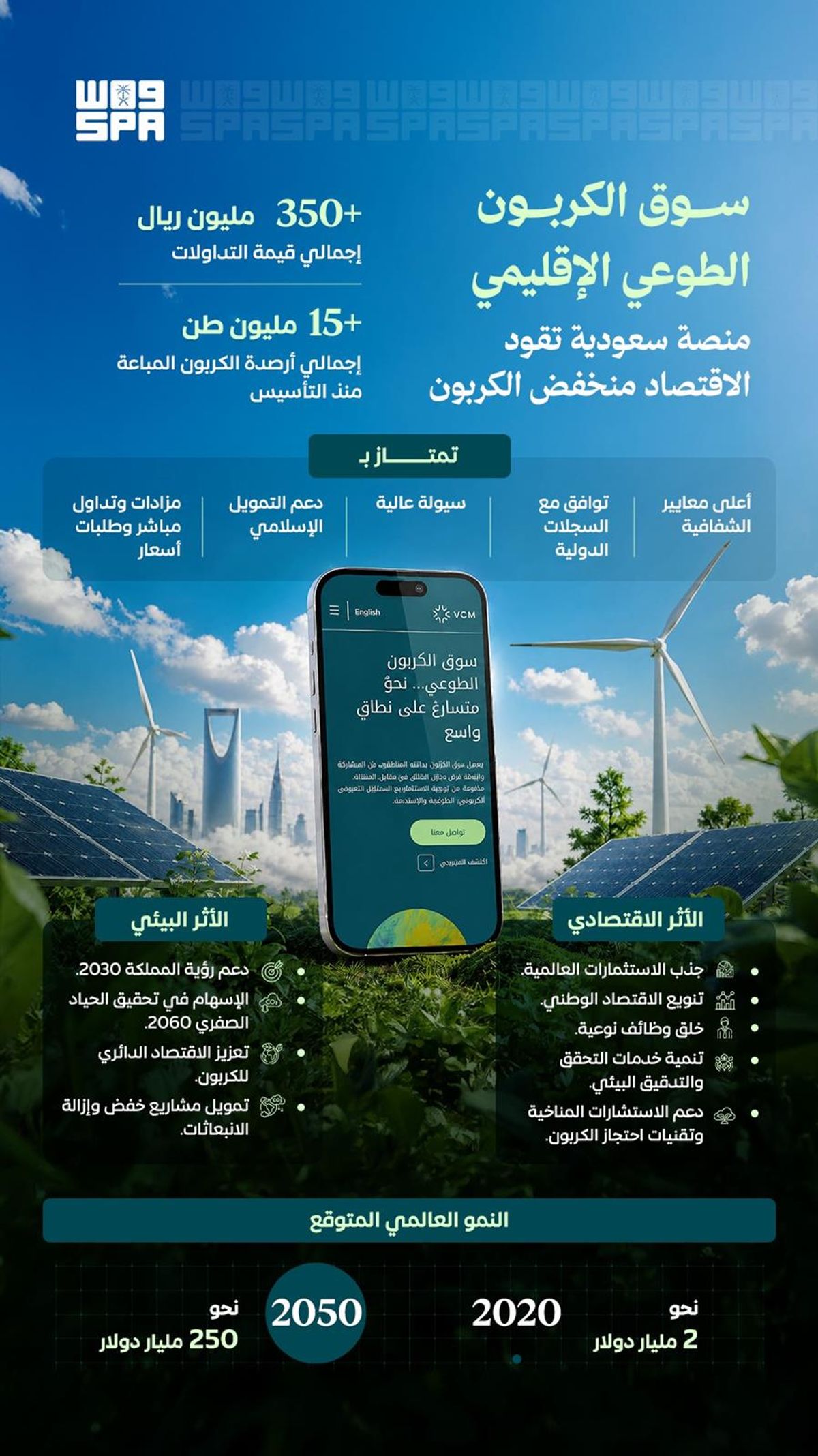
Saad added that the company offers a comprehensive suite of services, including an advanced institutional trading platform, advisory services, and technical support, strengthening Saudi Arabia’s position as a global carbon market hub. Since its inception, the company has achieved notable milestones, organizing three major carbon credit auctions in Riyadh, Nairobi, and Baku, selling over 15 million tons of credits valued at more than 350 million riyals (SAR), with participation from more than 40 local and international companies.
In November 2024, the company launched the region’s largest carbon credit trading platform, designed to global standards and supporting Islamic finance, offering diverse trading mechanisms and contributing to the development of advanced carbon market infrastructure.
Enhancing transparency and digital integration
The Voluntary Carbon Market signed a memorandum of understanding with the National Committee for the Clean Development Mechanism to enhance data exchange and facilitate electronic integration, improving transparency and providing accurate data on market activities in the Kingdom.
Supporting sustainability and economic development
Yara Albarlasi, a researcher at KAUST, stated that the market encourages investment in high-integrity projects such as waste management, land rehabilitation, renewable energy, and mangrove planting, supporting Vision 2030 and the net-zero target by 2060.
Similarly, economist Ahmed Al-Shehri emphasized that the voluntary carbon market offers a new path for diversifying the national economy and attracting global investment in sustainability and renewable energy sectors. It also creates quality job opportunities and supports the growth of an integrated economic ecosystem, including environmental verification and carbon capture technologies.
Growing international role and future outlook
Projections indicate that the global carbon market could reach $250 billion by 2050. The Saudi model offers a regulated market with high standards of governance and transparency, linked to global markets, enhancing the Kingdom’s credibility in this sector.
The market supports renewable energy, green hydrogen, and energy efficiency projects, as well as the development of national capabilities in emissions measurement and verification. It also promotes investment in afforestation and ecosystem restoration, positively impacting quality of life and reinforcing sustainable development.
Saudi Arabia aims to further integrate with global registries and strengthen its position as a global carbon market hub through international partnerships that support emission reduction and removal projects, reinforcing its leadership in building a more sustainable, efficient, and low-carbon global economy.