

Yemeni government: 'Operation Dawn of Yemen' marks new phase to restore state, end Houthi coup
Yemen’s government says President Rashad Al-Alimi’s launch of 'Operation Dawn of Yemen' signals a new stage in reclaiming state institutions and ending the Houthi coup.
Key Takeaways
AIThe Yemeni government has affirmed that President Rashad Al-Alimi’s announcement of the launch of 'Operation Dawn of Yemen' stems from his constitutional and legal responsibilities to protect citizens and safeguard Yemen’s sovereignty over its airspace, territory, and territorial waters.
According to the official Yemeni News Agency (SABA), the government explained that the operation marks a new phase in the process of restoring state institutions, ending the coup, and completing the liberation of remaining Yemeni territories, including the capital Sanaa. The government said the goal is to end the cycle of war, restore security, stability, and peace in Yemen and the region, and prevent an armed group from seizing the will of the Yemeni people and dragging them back into conflict whenever peace conflicts with its interests or those of its Iranian backers.
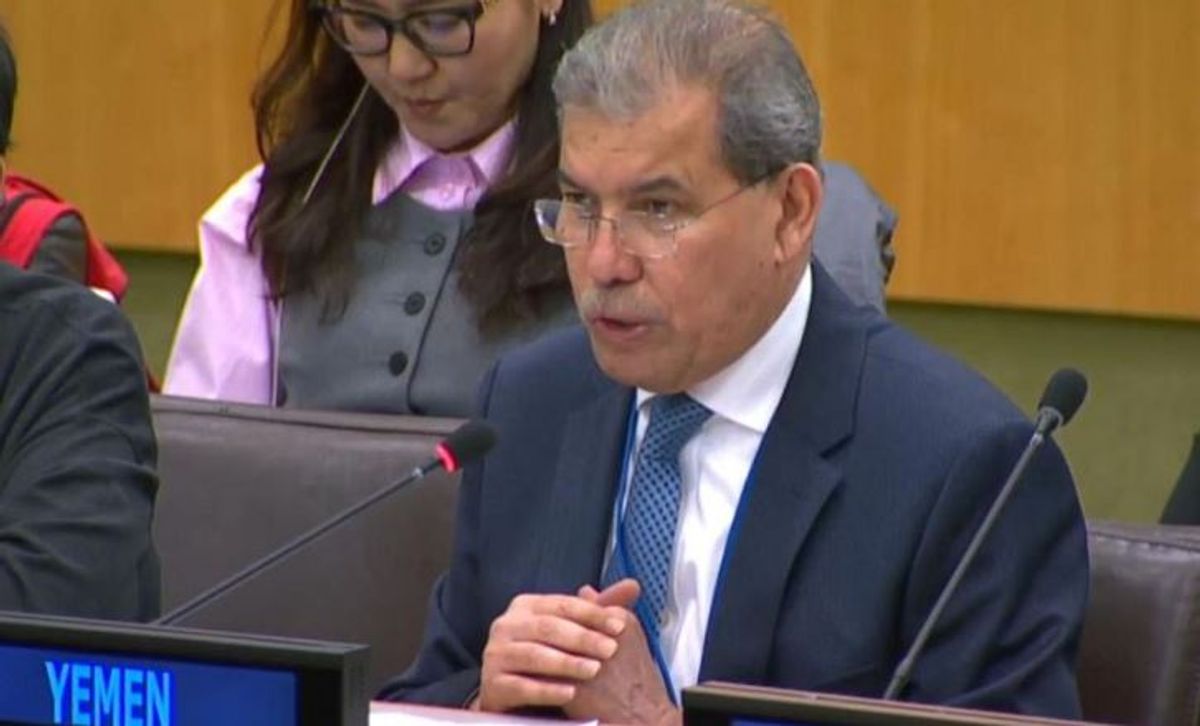
This came in a statement delivered by Yemen’s Permanent Representative to the United Nations, Ambassador Abdullah Al-Saadi, before the UN Security Council during an open session on the situation in the Middle East (Yemen).
The Yemeni government reiterated that these operations are not a war against any region, province, sect, or social group, but rather part of the government’s responsibility to protect its citizens, restore national institutions, and ensure that arms and decisions of war and peace remain under state authority, in accordance with the law. The government stressed that the essence of the conflict is between the Yemeni people and their legitimate government and state institutions on one side, and the Iran-backed Houthi militias on the other.
The government affirmed its commitment to international humanitarian law and international human rights law, emphasizing strict adherence to rules of engagement, protection of civilians and civilian property and infrastructure, prevention of acts of revenge, humane treatment of prisoners and wounded, investigation of any violations, and allowing those misled by the Houthis to return and align with the state and its institutions.
The government also stated that achieving genuine, comprehensive, and sustainable peace remains its steadfast goal, emphasizing that the desired peace is one that ends the coup, restores state institutions and their control over all Yemeni territory and national decision-making, protects citizens’ rights, and preserves their freedom and dignity, preventing Yemen from becoming a platform for threats to regional and international security. This, it said, must be based on agreed references, foremost among them UN Security Council Resolution 2216, and reaffirmed its support for the efforts of the UN Secretary-General and his Special Envoy to Yemen.
Ambassador Al-Saadi said: “Today’s session is being held amid ongoing escalation by the terrorist Houthi militias, threatening the lives of Yemenis, the security of neighboring countries and the region, and one of the world’s most important maritime corridors. This comes amid rapid developments at a critical juncture in the history of the war in Yemen, requiring us to place current events in their proper context and not view recent military developments in isolation from the roots and trajectory of this war over the past years.”
He added: “Before discussing the consequences of this escalation, it is essential to clearly identify those responsible. The Houthi militias started the war with their armed coup against the state, political consensus, and national unity twelve years ago, thwarted peace initiatives, and recently chose to end the truce, despite the Yemeni government’s repeated opportunities for peace and its bearing of significant political, economic, and humanitarian costs for the sake of de-escalation.”
He stressed that the Houthis responded to these opportunities by increasing armament, mobilization, and recruitment, expanding attacks on civilians and infrastructure within Yemen, targeting Saudi Arabia, threatening commercial shipping, and attempting to impose new military realities on the ground in Taiz, Mokha, and Bab Al-Mandab.
He noted that the government has repeatedly warned that continued leniency toward such behavior would undermine peace efforts, lead to a new round of violence, and deepen the humanitarian crisis, adding that this is exactly what has happened.
Ambassador Al-Saadi explained that the humanitarian cost of this escalation reveals the nature of the project the government is confronting, noting that at least 100 children were killed in clashes last September alone, as the Houthis continue to recruit and deploy children to the frontlines. “These children belong in schools and with their families and communities, not on the battlefield,” he said.
He pointed out that Houthi attacks in recent weeks have forced thousands of Yemenis into displacement, with the number of internally displaced persons reaching around 200,000, most of whom have been displaced three or four times, while the number of displaced in Djibouti has reached about 3,000, all in urgent need of humanitarian assistance.
He stated that Houthi attacks have targeted residential neighborhoods, markets, schools, camps for the displaced, and civilian and service facilities, exacerbating pressure on communities already exhausted by years of war.
He added: “The day before yesterday, Houthi militias targeted Aden International Airport with two ballistic missiles, one of which landed near the runway just before a civilian flight was due to land, directly endangering passengers, staff, and aviation safety, in a serious attack reminiscent of their terrorist assault on the airport in December 2020.”
Ambassador Al-Saadi confirmed that the Houthi militias have expanded their brutal attacks on Saudi Arabia, targeting airports, civilian and economic facilities, and vital sites. He said these crimes again reveal the true nature of the Houthis as a terrorist group that does not hesitate to target civilians and vital infrastructure, seeking to distract from its violations and crimes against Yemenis in service of Iranian interests in the region, and showing disregard for innocent lives and international laws and norms.
He explained that the armed forces, with support from the Saudi-led coalition, are defending the Red Sea and Bab Al-Mandab, thereby protecting a vital artery on which the entire global economy depends. He noted that while freedom of navigation is a shared interest, its protection is also a shared responsibility, and Yemenis should not bear the burden alone.
Ambassador Al-Saadi called on the Security Council to take a clear stance holding the Houthi militias responsible for the escalation, to effectively implement its resolutions, especially Resolution 2216, and to take practical and firm measures to curb networks of financing and smuggling, halt the flow of weapons, technology, expertise, and dual-use components to the Houthis, and hold accountable those supporting them, particularly the Iranian regime, while enhancing cooperation with the Yemeni government to counter smuggling and financing networks fueling the war.
He also called for political, economic, humanitarian, and security support for state institutions, and for strengthening their capacity to protect civilians and aid those displaced by the recent escalation, who join millions of Yemenis already displaced by the Houthis inside and outside the country.
He expressed deep appreciation and gratitude to Saudi Arabia—its leadership, government, and people—for their steadfast support for the Yemeni people and government, and their continued assistance to state institutions and the national economy, including a new budget support package at the start of this month, as the country faces unprecedented economic and humanitarian challenges.
He said: “This support is not limited to defense, security, and the economy, but extends to the lives, dignity, and stability of Yemeni families. King Salman bin Abdulaziz, in response to a request from President Rashad Al-Alimi, has ordered measures to regularize the status of Yemenis residing irregularly in the Kingdom—a vital humanitarian initiative that opens new opportunities for Yemenis struggling at home, easing the burden on thousands of families during these exceptional circumstances.”
He stressed that the international community’s responsibility toward Yemen should not be limited to crisis management or responding to security consequences, but must extend to protecting Yemenis, supporting their livelihoods, and enhancing the capacity of state institutions to fulfill their essential obligations.
He added: “While Saudi Arabia has set a practical example of solidarity, we call on our international partners to fulfill their responsibilities, double their economic and humanitarian support for the Yemeni government, and back its efforts to restore stability and end the suffering that worsens daily due to the escalation by the Iran-backed Houthi militias.”
View the post on X