

OpenAI claims AI system solves 90-year-old Navier-Stokes problem
OpenAI says its internal AI has solved the Navier-Stokes existence and smoothness problem, one of the seven Millennium Prize Problems in mathematics.
Key Takeaways
AIOpenAI has announced that one of its internal AI systems has solved the Navier-Stokes existence and smoothness problem, one of the seven Millennium Prize Problems and among the most challenging open questions in mathematics. The company published a research paper detailing the solution, along with a formal proof verified in the Lean language for automated checking.
The problem concerns equations describing fluid motion that have puzzled scientists for nearly 90 years and are used in aircraft design, weather prediction, and blood flow studies. The central question: can a three-dimensional fluid flow that starts smooth develop a 'singularity'—meaning the fluid's velocity becomes infinite in a finite time?
What did the system prove?
The AI produced a proof showing that a stationary fluid can develop a singularity in finite time, while its energy remains finite and it is subjected only to smooth external forces. This resolves the problem by proving cases 'C' and 'D' in the official Clay Mathematics Institute formulation.
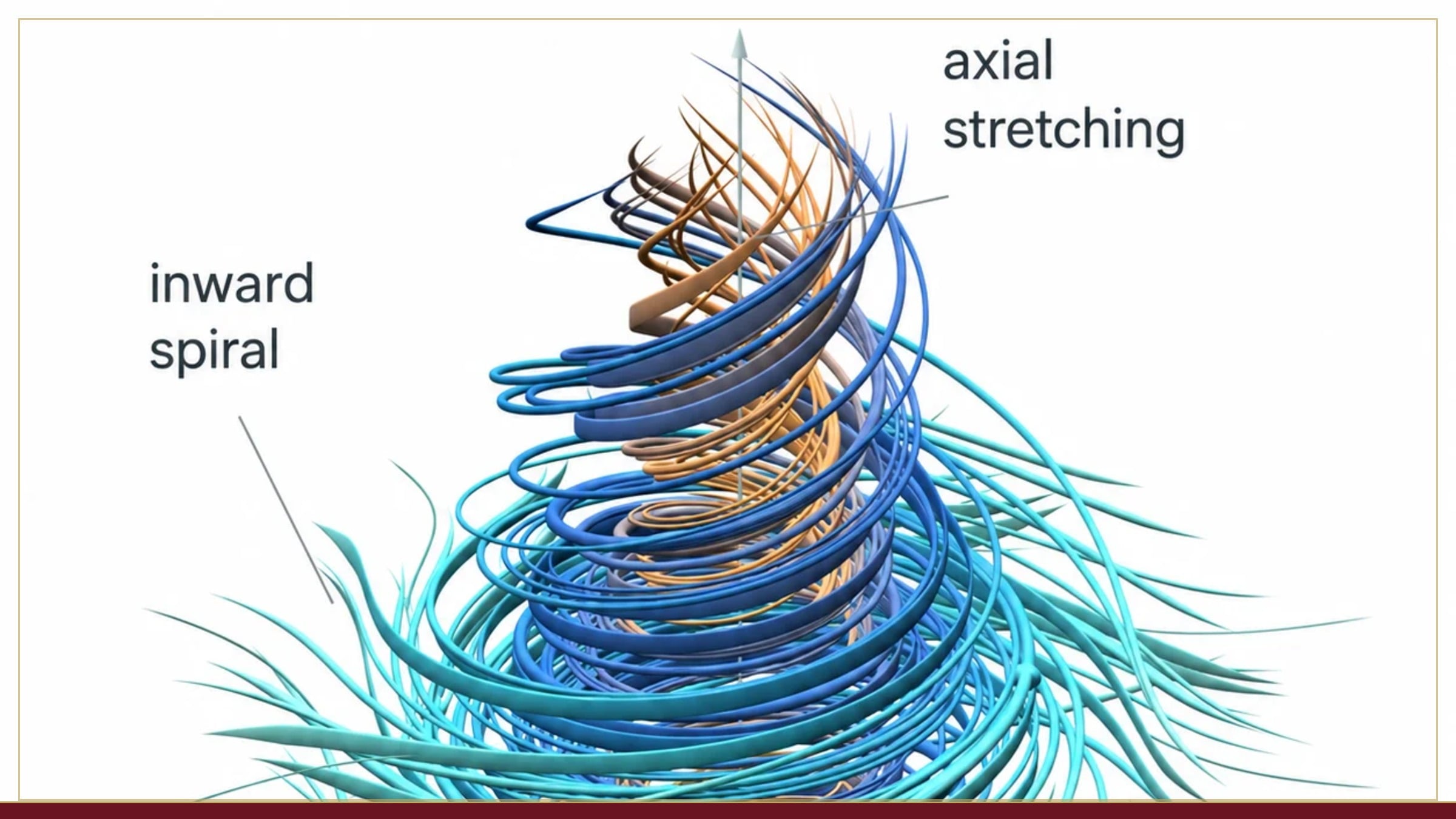
According to OpenAI, the solution involves a vortex that twists inward and stretches until it resembles a strand of spaghetti, with its core shrinking and accelerating in a way that keeps the energy finite, as required by physical laws. The technical challenge was to ensure the breakdown arises from the fluid's own motion, not from any externally imposed infinite force.
How was it achieved? 10,000 agents, 2.7 million messages
The company explained that since August 28, it has been training a new internal model described as "much more capable" than its public GPT-6 Astra, with training ongoing and performance improving.
On September 1, after rumors circulated about solutions to two Millennium Problems, OpenAI launched an effort to evaluate its model on all open problems, using a system of cooperating agents. About 10,000 agents worked in parallel, equipped with tools including a cached copy of the internet and code execution capabilities.
The agents reached the solution on Saturday, September 5, after about 88 hours of work. Formalization and verification took an additional 17 hours. Across all problems, the agents exchanged 4.9 million messages and generated about 300 billion output tokens, with 2.7 million messages and 130 billion tokens dedicated to the Navier-Stokes problem alone.
A surprise along the way: Euler problem solved
During the process, the agents were tasked with testing "easier" problems and succeeded in resolving the regularity of the Euler equations (Navier-Stokes without viscosity) in the version without external forces. Around 100 agents worked together for about 50 hours, prompting the company to focus its resources on Navier-Stokes.
Parallel work and acknowledgment of precedence
OpenAI noted that its effort began after a rumor that was later linked to the work of Levent Alpoge, an employee at Anthropic, and Tristan Buckmaster, a mathematics professor at New York University, who resolved the forced version of the Euler problem.
The company said it offered them a joint announcement and access to its tools, acknowledging their precedence in the forced Euler problem. OpenAI stressed that its researchers and agents had not seen their work before its public release, and that the two proofs are fundamentally different.
"We will not claim the prize"
OpenAI stated that its aim in publishing the result is to report the pace of its models' progress and that it does not intend to claim the Millennium Prize for this result. The company described the achievement as "a snapshot in time, not a peak" in the evolution of artificial intelligence, emphasizing its focus on understanding the new model and guiding capability development with greater caution.